
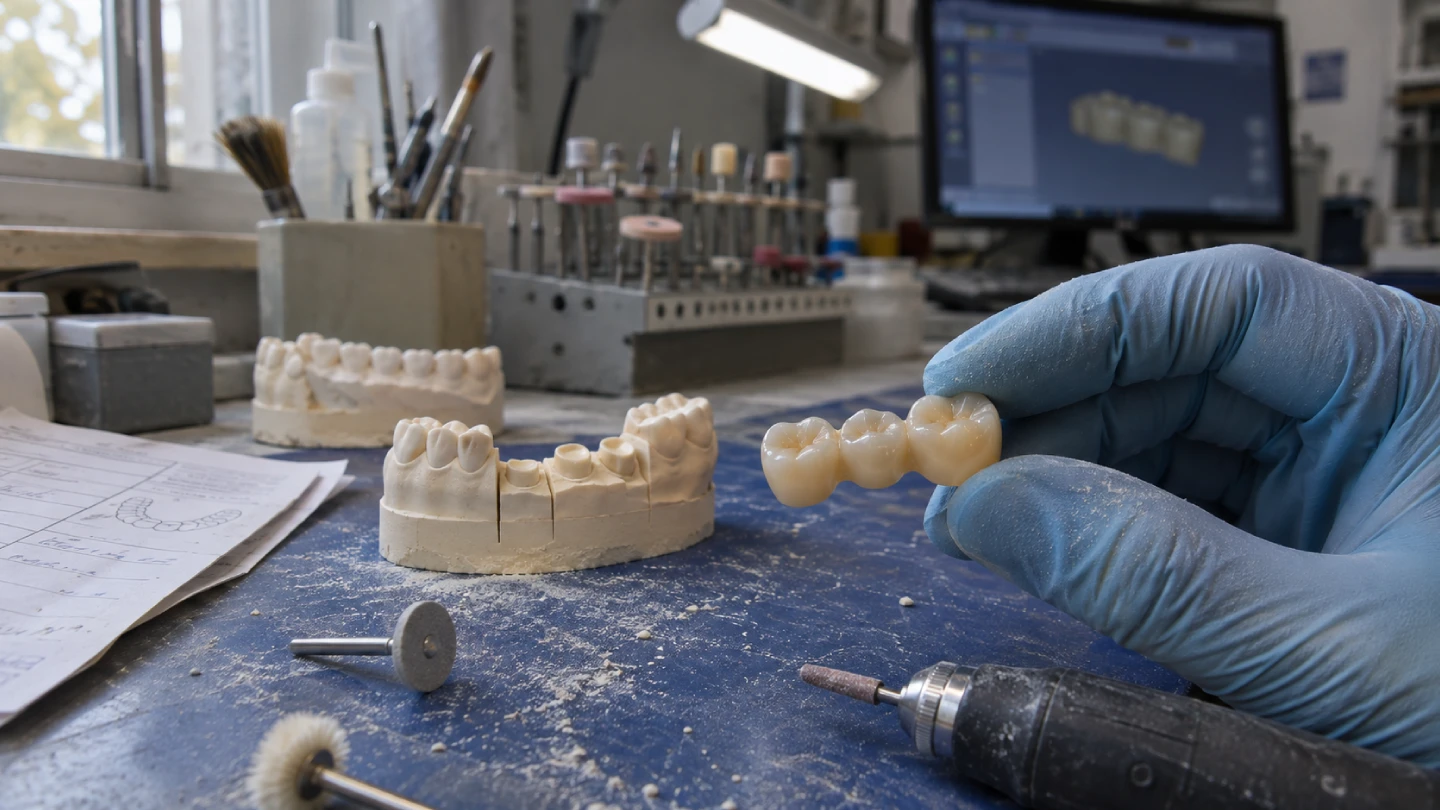
Temporary teeth do more than keep a patient smiling for a few weeks. The interim restoration shapes tissue, protects the preparation, carries the occlusion, and anchors the patient’s expectations for the final. When it fails, the whole case slides. Chart entries vary — “temp teeth,” provisional crown, interim partial, temporary prosthesis teeth on implants — the lab-side work that keeps any of them from failing is largely the same: material choice, design against the real failure modes, clean CDT handoff, predictable lead time, and tight inputs from the clinic.
Istar Dental Lab has produced fixed and removable restorations since 2012. Facilities in Shenzhen and Huizhou run a digital workflow in-house: CAD design, milling, 3D printing, layering, QC. Our FDA device listing covers custom crowns, fixed bridges, inlays and onlays, veneers, custom implant abutments, implant superstructures, full and partial dentures, and temporary restorations, so provisional work ships under the same registration as the finals.
What “temporary teeth” refers to
“Temporary teeth” is the patient phrasing; “temp teeth” is the chairside shorthand. The precise clinical terms sit in the ADA’s Glossary of Dental Clinical Terms: provisional (restoration placed for a limited time, meant to be replaced by a definitive restoration), interim (a prosthesis used for a limited interval of therapy or evaluation), and immediate (fabricated for insertion right after extraction or surgery). They are not interchangeable, and the distinction matters when a payer reads the claim.
For plan-of-care purposes, temporary teeth fall into three families:
Family | Who gets it | Typical fabrication | Expected wear window |
|---|---|---|---|
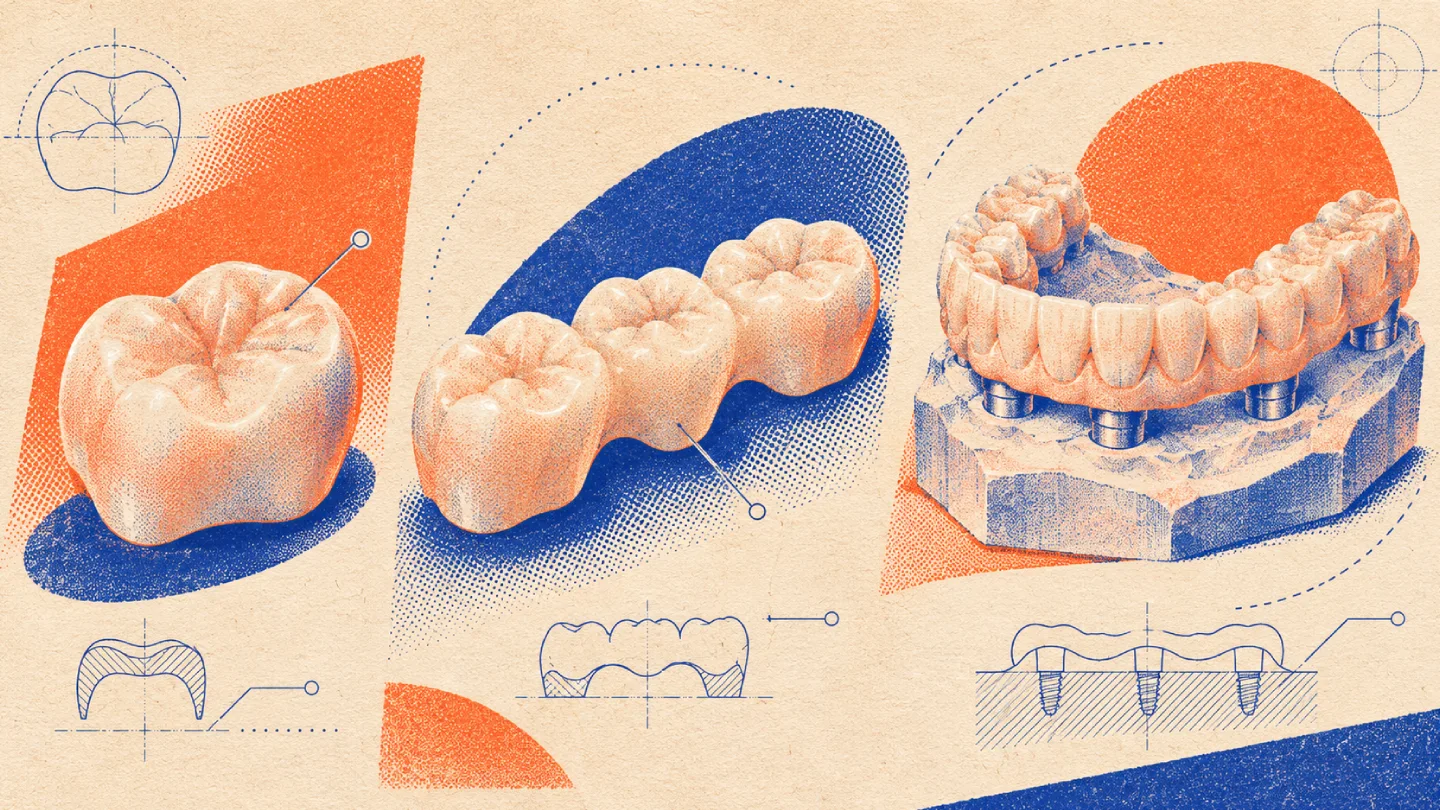
Single-unit and short-span fixed provisionals | Crown-and-bridge preps, veneer preps | Milled PMMA, printed PMMA/urethane-based resin, or bis-acryl at the chair | Weeks to a few months |
Longer-term fixed provisionals | Full-mouth rehab staging, cases waiting for perio or endo review, phased esthetic work | Milled PMMA with reinforced connectors; print + layer when esthetics are tight | Up to the end of the staging phase |
Implant-supported provisionals and immediate-load full-arch | Single-tooth implants, All-on-X cases, graft protection | Printed or milled PMMA shells on temp cylinders, PMMA full-arch prototypes on Ti bars | Through osseointegration or until the final bridge is confirmed |
Removable options a patient may mention — a flipper (interim partial denture) or an Essix retainer with a pontic — are chairside and removable-side work. When a dentist routes a flipper or Essix case through the lab, it is built the same way as an interim partial: wax-up or digital set-up, try-in, process, polish, QC. The design calls are the clinician’s.
Choosing the temporary by wear window and site
Two questions drive the material and design choice: how long will it be in service, and where in the arch does it sit.
Wear window
The ADA’s definitions and payer policy both split “temporary” at roughly the 60-day mark. Cigna’s 2026 Dental Clinical Coverage Determination Guidelines describe D5820 and D5821 as interim partial dentures with an anticipated limited life expectancy of less than six months while a definitive prosthesis is planned, and most payer definitions of D2799 reference a limited duration that may extend through staged treatment. Three practical tiers follow from that:
- Short-term provisional (days to ~6 weeks). Printed resin or milled PMMA shells, light finish, minimal occlusal adjustment room. Lab turnaround is 2–3 working days once files are complete.
- Medium-term provisional (6 weeks to several months). Milled PMMA with reinforced connectors on bridges, polished and lightly characterized. A reline or rebase appointment should be planned if a soft-tissue change is coming; immediate dentures routinely need this per the ADA (Dentures | MouthHealthy).
- Longer-term provisional (phased rehab, implant staging). Milled PMMA, extra bulk in connectors, layered or stained for esthetics. For full-arch cases a PMMA prototype is built first, verified intraorally, and the approved occlusion and emergence are migrated to the final.
A clinical study of long-term temporary fixed dental prostheses published in 2025 reports fracture in 14.1% of restorations and decementation in 18.1% (PubMed 40069515). The paper supports the use of long-term provisionals for specific indications; the numbers are a reason to design in the margins, not a reason to avoid them.
Site
Anterior and posterior cases ask different things of a temporary.
Anterior. The failure the patient notices is esthetic: a cervical dark line, the wrong value under translucent lip tissue, or a shape that reads flat on photo. Lab-side handling is layered PMMA or printed resin with stain-and-glaze, matched against intraoral photos and a shade reference held wet in natural light. Veneer provisionals that live beyond a couple of weeks tend to benefit from a mock-up scan sent alongside the preparation scan.
Posterior. The failure the patient notices is functional: a chipped cusp, a loose crown after a sticky meal, a flexed connector on a 3- or 4-unit bridge. The lever is cross-section at the connector. Five units is the usual working threshold for a “long-span” case; beyond that, non-axial forces during lateral excursions become the dominant failure driver. In parafunction, connectors go thicker, fiber reinforcement is added where indicated, and nightguard planning becomes part of the design conversation.
Failure modes at the bench
Fracture at the connector
A clean break through the smallest cross-section of the connector, usually mesiodistally on a posterior temp bridge.
The first check is connector dimensions in the CAD file. Published guidance on the mechanical properties of CAD/CAM provisional materials shows meaningful differences across milled PMMA, bis-acryl, and 3D-printed resins — the mechanical-properties review published in 2022 (PMC9269394) and the 2023 follow-up on printed provisionals (PMC10295536) both cover flexural strength, hardness, and wear. Long-span posterior temps default to milled PMMA; printing is appropriate when the span is short and the forces are moderate.
The second check is occlusion. If the temp carries contacts outside centric or carries full lateral guidance alone, it will break again on the same patient. Occlusal design concerns are flagged on the design preview rather than discovered after a remake.
Decementation and screw loosening
The patient comes back with a temp in a Ziploc bag, or an implant provisional that keeps spinning on the healing abutment.
Cement-retained temps. Marginal fit does most of the work. If the preparation scan shows a soft margin, bleeding, or saliva pooling, a rescan is requested rather than guessed. ADA’s resource on wearing a crown (JADA, 202100616-4/fulltext)) is a one-page refresher for patients between visits.
Screw-retained temps. For single-implant provisionals and All-on-X prototypes, screws are pre-torqued to the manufacturer’s recommendation, passive fit is verified on the model, and the case ships with the matching screws and driver when requested (that supply is paid). The FDA’s device listing covers the superstructure, not the implant body (FDA: Dental Implants, What You Should Know).
Marginal opening
The temp seats, but a probe catches at the finish line, or the patient reports sensitivity to cold within the first week.
Lab-side: marginal integrity is checked on a model and under magnification before shipment. The review of marginal integrity in provisional resin restorations (ResearchGate, 2014) covers how different materials behave at the margin.
Clinic-side: scan quality at the finish line sets the ceiling for marginal fit — isolation, no bleeding, continuous read of the margin. Scan quality at the margin predicts fit at the margin.
Shade shift and wear
The temp looks right on day one and chalky at the three-month visit, or the opposing dentition shows wear facets against a printed provisional.
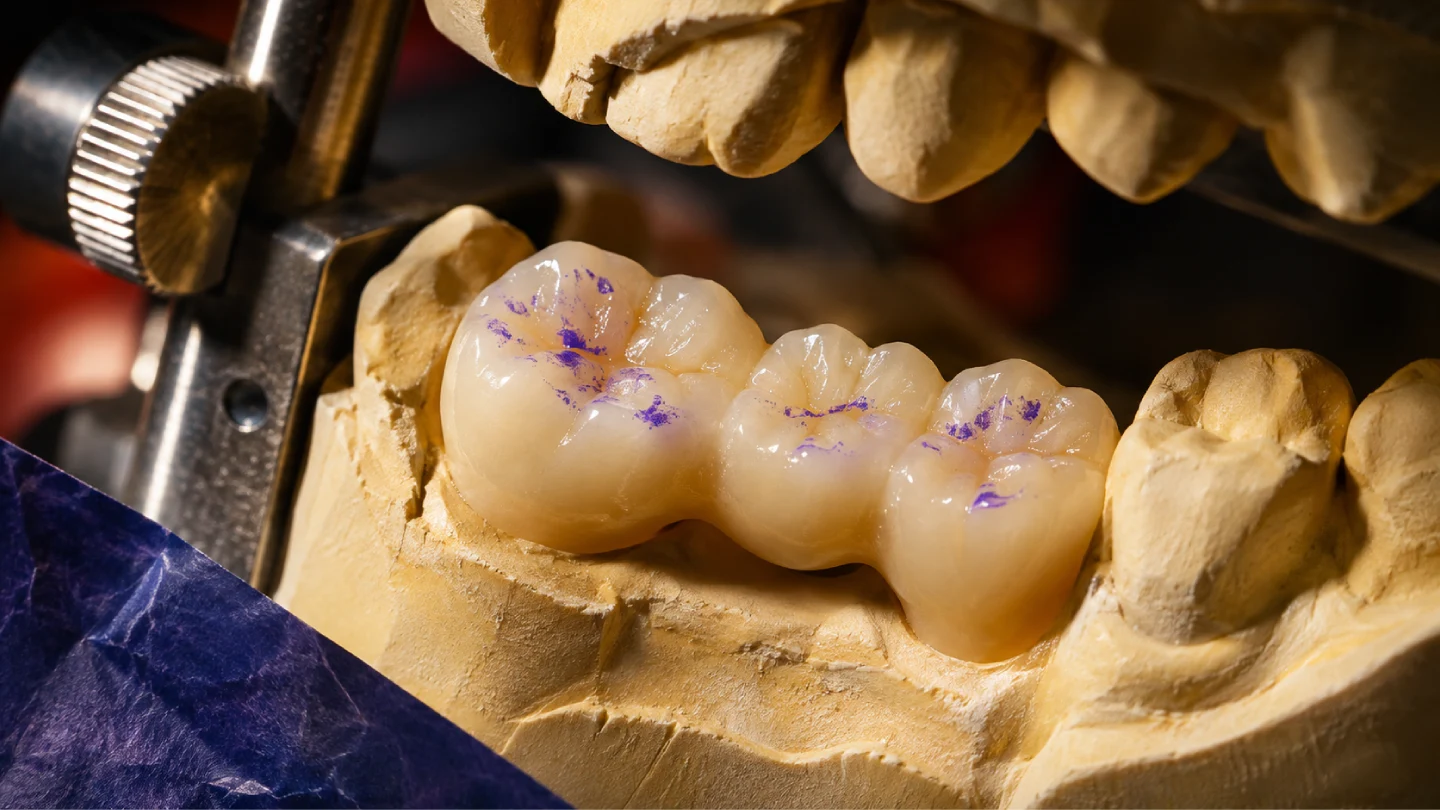
Lab-side: shade on long-term provisionals is handled the same way as on finals — layered or stained, photographed under correct light, matched to the shade tab held wet. Printed PMMA color stability has improved but still drifts under coffee, tea, and nicotine. For staged cases the planned wear window changes the material choice.
Opposing wear: published wear data on 3D-printed provisionals is reasonable but not identical to milled PMMA. If the opposing is a crown that will be redone anyway, this is a non-issue; if the opposing is a natural, lightly worn tooth, milled PMMA with a polish that spares the opposing cusp is the usual choice.
Tissue response and emergence profile
A pink mark at the mesial papilla, a flattened ridge under an immediate denture, or soft-tissue overgrowth around an implant provisional.
For implant provisionals. The emergence profile captured in the healing phase carries straight into the final. The clinician records the sulcus with a scan of the custom healing abutment or the provisional in situ. The soft-tissue contour is lifted into the final through an impression transfer or by overlaying the approved PMMA prototype onto the final design. The prototype’s organic surfaces are treated as specification.
For removable immediates. The ridge changes under function. A reline window is planned and documented in the treatment letter.
Longer biology. For fixed and removable prostheses, design and daily maintenance affect long-term tissue health — the 2022 narrative review on fixed prostheses and periodontal health (PMC8883934), the 2024 retrospective-prospective study on the periodontal health of abutment teeth (PMC11976071), and the overview of iatrogenic periodontal damage from restorative procedures (PMC4541299) are the usual references.
Chairside fix vs send-back
Chairside | Send back |
|---|---|
Minor occlusal high spot | Visible crack |
Small marginal relief | Won’t seat after the usual checks |
Polish touch-up | Open margin on probe at placement |
Any screw-retained temp that spins |
On patient instructions, the ADA is explicit in its guidance on denture care and maintenance that over-the-counter glues can contain chemicals that are not appropriate for a dental prosthesis. The standing instruction for a loose temp outside hours is: do not use household adhesive, keep the piece dry and intact, call the office.
Materials used, and their indications
For temporary crowns and bridges, the main materials are milled PMMA and 3D-printed resin. For removable immediates and interim partials, heat-cured PMMA and acrylic denture teeth. Current stock:
Family | Materials in stock | Indications |
|---|---|---|
Milled PMMA pucks | Ivoclar and Aidite grades | Single units, short-span bridges, longer-term provisionals, All-on-X PMMA prototypes |
3D-printed temp resin | Dental photopolymer resins run on calibrated printers | Diagnostic wax-ups, printed denture bases, short-term provisional shells |
Composite resin blanks and systems | Shofu and Ivoclar systems | Characterization, chairside-support fit kits |
Framework materials for All-on-X | Commercially pure titanium and titanium alloy bars; multi-unit abutments; temporary cylinders; matching screws | Full-arch temporaries and prototype bridges |
Denture base and tooth materials | Lucitone 199 and domestic PMMA bases; VITA, Ivoclar, Shofu, and Supurox denture teeth | Immediate dentures, interim partials, converted temporaries |
Every batch is tracked by brand, origin, lot number, and certificate. Case paperwork can be sent with the shipment on request.
Scope boundaries: custom trays and implant bodies are outside the service. Surgical guides, verification jigs on request, printed models, and the temporary bodies that go on top of implants are in scope.
Full-arch temporaries and the PMMA prototype
Full-arch cases are where “temporary prosthesis teeth” becomes a dedicated workflow rather than a translation.
Istar supports immediate-load temporary bridges and the final bridge for All-on-X. Structural options include full zirconia, titanium bar with zirconia or resin teeth, titanium bar with PMMA, and PFM. The choice is driven by vertical space, parafunction, esthetic demand, and cost.
Sequence:
- Records. Full-arch scan with scan bodies, bite record, face-bow or esthetic photos, CBCT, implant system labels. Where implants sit far apart, a verification jig is built for intraoral try-in before cutting the bridge.
- PMMA prototype. A PMMA bridge is milled from the approved design, delivered with matching screws, and worn long enough to confirm occlusion, VD, midline, lip support, speech, and esthetics.
- Try-in validation. Clinician checks seating, occlusion in CR and excursions, VD, phonetics, and esthetic acceptance; result is documented in photos.
- Digital transfer to the final. The approved PMMA prototype is scanned and overlaid onto the implant positions in the design software using the implant interface as the geometric reference. The occlusion, VD, esthetic contour, and screw channels inherit from the approved prototype. The intaglio surface rebuilds against the current scan, not the modified prototype, so the final is passive.
- Final bridge. Milled, finished, QC’d, shipped with the matching screws and the design file.
The academic basis for the staged approach is covered in the ITI consensus on early and immediate restoration and loading (ITI Group 3, 2004) and the esthetic-zone follow-up and literature review (PMC8457954). The biological rationale for time-staging is covered in the narrative review on osseointegration (Frontiers of Oral and Maxillofacial Medicine, 2021).
Service life for the temporary prosthesis ends when the final is ready to carry the forces and the esthetic approval is in. Clinician-oriented explanations of the duration question appear at Winterholler Dentistry on how long a temporary prosthesis should be worn and at Dental Implants London on what “provisional” actually means in implant dentistry.
Case submission
Accepted files: STL, PLY, OBJ, DCM, native CAD. Raw DCM is preferred on 3Shape; STL/PLY exports work for Medit and Trios.
Scans must have isolated, dry preparations with a continuous read of the finish line; a full opposing arch to the last molar; and a bilaterally verified centric bite (a separate buccal scan at centric helps). For long-span and full-arch work, scan continuously in one direction with 30% or better overlap, and add a verification jig when implants sit far apart.
If a physical impression is used, VPS is the first choice and polyether is acceptable. Alginate is not recommended for international shipping; if nothing else is available, pour it and ship the stone model.
Anterior cases should include a full-face smile, repose, lateral, intraoral close-up, and a shade-tab photo taken wet next to the natural tooth under natural light; add a reference smile or DSD for cosmetic work. Implant cases need scan body brand and model, implant brand and platform, and the implant label from the surgical record; flag any third-party scan body or verification model already built.
Lead time and remakes
Standard fixed crown-and-bridge production is 2–3 working days from receipt of a complete, approved case; Chinese weekends and public holidays do not count, and the clock pauses while a case waits for design approval or a missing file. A requested design preview adds 1–2 days. Shipping sits on top of lab time via DHL, FedEx, UPS, or SPIDER (France), with duties and brokerage on the customer, and multiple cases can be consolidated to lower per-case freight.
Internal QC fails are remade before the piece ships. Design-related issues inside the lab’s scope — a connector miscalculation, a misread finish line — are remade at the lab’s cost. Cases where the material or design was chosen against a written lab note carry a rework fee that is agreed before work resumes.
About Istar
Istar Dental Lab has produced fixed and removable restorations since 2012, with facilities in Shenzhen and Huizhou running an in-house digital workflow across CAD design, milling, 3D printing, layering, and QC. Full-service capacity covers single crowns, bridges, All-on-X arches, and removable work in both normal and peak seasons, and the FDA device listing extends from crowns, bridges, veneers, inlays and onlays through custom implant abutments, implant superstructures, full and partial dentures, and temporary restorations. Clients and partner labs across the United States and Europe arrange on-site visits in Shenzhen or Huizhou, or a live video audit through the sales team.
FAQ
How is a provisional crown different from an interim partial on a claim?
They sit under different ADA definitions. A provisional (D2799) is placed when further treatment or further diagnosis is needed before a final impression; an interim partial denture (D5820/D5821) is a removable prosthesis for a limited period while a definitive prosthesis is planned. The edge cases are covered in the Limoli & Associates write-up.
When should a long-term fixed provisional be remade rather than relined?
Three signals: cumulative wear facets or chipping that have shifted the occlusion, a margin that opens on probe, and shade shift the patient can see. Any two of the three usually point to remake. The 2025 clinical paper on long-term temporaries (PubMed 40069515) reports fracture at 14.1% and decementation at 18.1% — the two failure modes a design accounts for from the start.
Does Istar ship immediate-load temporaries for All-on-X cases?
Yes. Full-arch PMMA prototypes on titanium bars ship with matching screws, and the digital transfer from approved prototype to final bridge is part of the workflow. Multi-unit abutments and temporary cylinders can be supplied on request (paid separately).
What scan protocol does a full-arch case need?
Continuous scan in a single direction, scan bodies on all implants, 30% or better overlap on cusps. For wider inter-implant spans, a verification jig is built and tried in before the bridge is committed. If the jig does not seat passively, the bridge will not either.
Are material brand, origin, and lot records available for a case?
Yes. Material certificates stay on file by case ID and can be sent with the shipment on request.
A patient’s temp comes loose outside office hours. What should the office tell them?
Keep the piece dry and intact, do not use household adhesive, call the office in the morning. The reasoning sits in the ADA’s guidance on denture care: household glues can contain chemicals that are not appropriate for a dental prosthesis, and over-the-counter zinc-containing adhesives have their own warnings on packaging. An intact piece is usually recemented at the next appointment; a cracked piece is remade.
Are factory visits available?
Yes. Clinics, dental groups, and partner labs arrange on-site visits and production-line tours in Shenzhen or Huizhou, and live video audits where travel is not practical. Visits are scheduled through the sales team.