
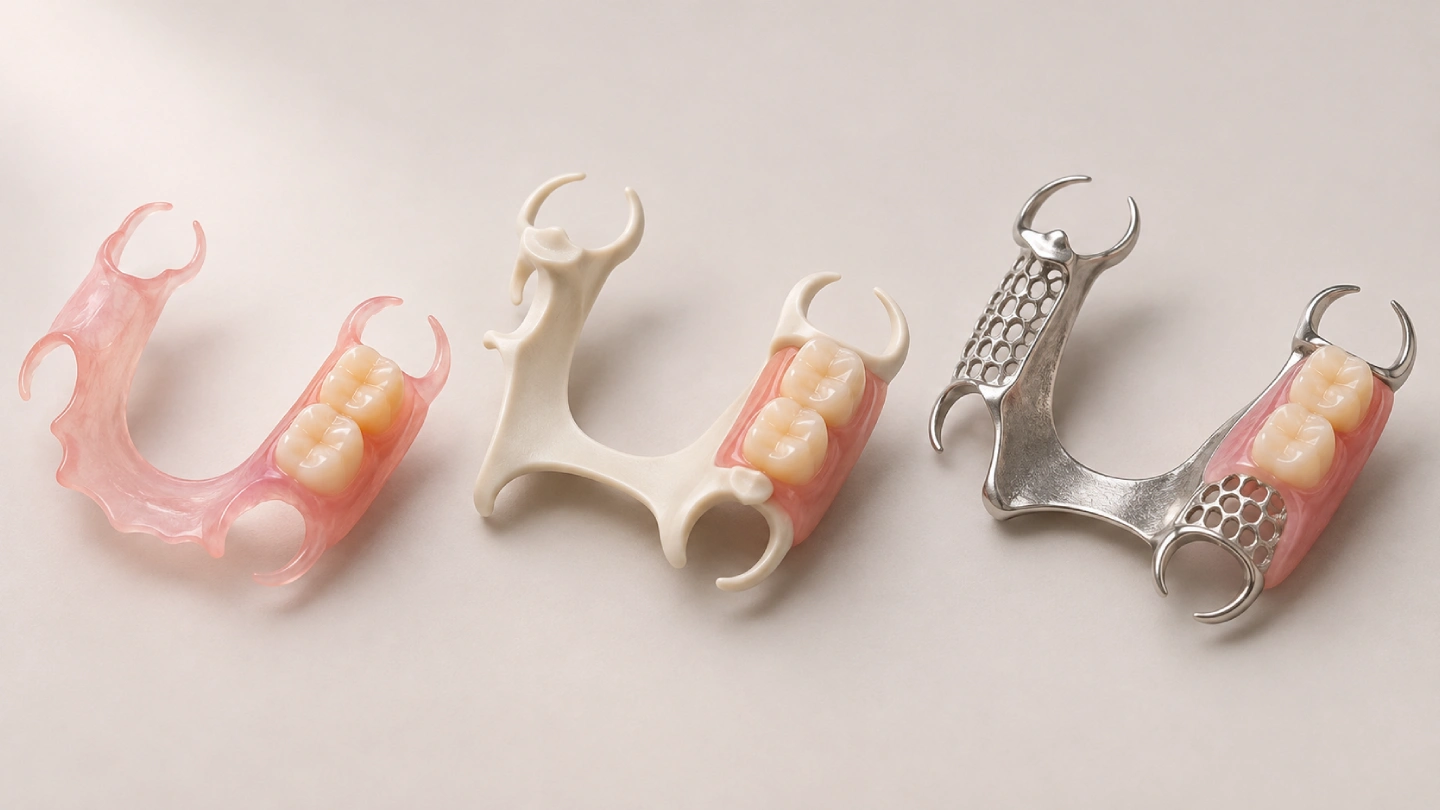
“Metal-free” is a request we hear every week. It’s rarely a single request. For some patients it means no visible metal on the smile. For others it means no cast framework. A smaller group wants no metal anywhere in the mouth. These three asks lead to three different prescriptions, and treating them as one is where most trouble starts — including yours when the case comes back for adjustment.
At Istar Dental Lab we build the full set of removable partial options — cast cobalt-chromium (CoCr) frameworks, titanium frameworks, PMMA resin-base partials, flexible thermoplastic partials (including Valplast-style nylon and polyolefin alternatives), rigid polymer frameworks such as PEEK and Ultaire AKP, and hybrid designs. How we decide between them case by case comes next, leaning on published evidence where it exists and marking the gaps where it doesn’t.
For a specific case, send us the scan and prescription and we’ll come back with a design proposal.
What “metal-free” actually means
The phrase is used three ways. They are not synonyms, and the design that satisfies one may not satisfy another.
Request | What the patient usually means | Design that fits |
|---|---|---|
No visible metal | Don’t let me see shiny clasps when I smile | Hybrid cast framework with resin or thermoplastic esthetic clasps; rotational-path designs; precision or semi-precision attachments; I-bar or clear acrylic clasps on a resin base |
No metal framework | Keep the whole appliance polymer; I don’t want a cast understructure | Flexible thermoplastic partial (nylon/polyamide, polyolefin, acetal) or rigid polymer framework (PEEK, Ultaire AKP) |
No metal anywhere | Zero metal in contact with my tissues | Fully polymer appliance; still verify every component — some commercial “flexible” products pair a resin base with wire or small metal retainers |
Pin this down before the prescription is written. A peer-reviewed review of nonmetal clasp dentures in PMC makes the same point: an “acrylic partial” does not automatically mean clasp-free or metal-free, and a resin base may still carry wire clasps.
The material families we work with
A “flexible partial” is not one material. Handling, finish, repair and clinical behavior change with the chemistry.
Nylon and polyamide thermoplastics
Heat-softened resin injected into a flask. Valplast is the best-known example; TCS Unbreakable is another nylon system; TCS iFlex is a polyolefin, not a nylon — different polymer, different behavior. The base and the esthetic clasps are usually the same resin.
- Why it’s chosen: flexes into undercuts, usually hides clasps, light.
- What to prescribe for: short, bounded Kennedy Class III spaces where appearance is critical, or interim replacement.
- What to tell patients: polyamide is hygroscopic — water uptake, surface roughness and polishing difficulty make these appliances more susceptible to staining over time than well-finished PMMA.
- Repair, reline, adding teeth: possible but harder than acrylic. Nylon-to-acrylic bonding is a known limitation. Valplast’s own guidance directs patients to a qualified lab for tooth additions rather than chairside grinding.
Acetal and polyester thermoplastics
Thermoflex / Therm-o-Flex is identified by Dentsply Sirona as acetal (polyoxymethylene) — a different polymer from nylon. ThermoSens is polyester-based. The two product names are often used interchangeably; they shouldn’t be.
Acetal is stiffer than nylon and can be used for the whole base, for the clasp arms only, or combined with a resin base.
Rigid polymer frameworks: PEEK and Ultaire AKP
Metal-free options that behave like a framework rather than a flexible pad.
- PEEK (polyether ether ketone): milled from pucks, finished with resin base and acrylic teeth bonded on. Published unfilled PEEK flexural moduli start around 2.73 GPa, with values varying by formulation and test.
- Ultaire AKP: an aryl ketone polymer, not PEEK. Marketed as Dentivera discs by Solvay / National Dentex. The FDA 510(k) K160498 record classifies it as Class II under 21 CFR 872.3760, product code EBI. The clearance is specific to that product and that labeled use, which is the point to make to a patient asking for “FDA-approved” metal-free materials.
Both need a design matched to the material. Running a cobalt-chromium design unchanged through a polymer puck is not sound material selection.
Cast cobalt-chromium and titanium
The mechanical reference. Cast CoCr frameworks are rigid (~210 GPa in published laboratory values), well-documented and predictable to reline. Titanium is lighter and used where biocompatibility or weight matters more.
If a case needs reliable rests, cross-arch rigidity or control of a long distal-extension saddle, this is almost always where it should land, and no amount of material enthusiasm changes that.
Reading the mechanical table before you prescribe
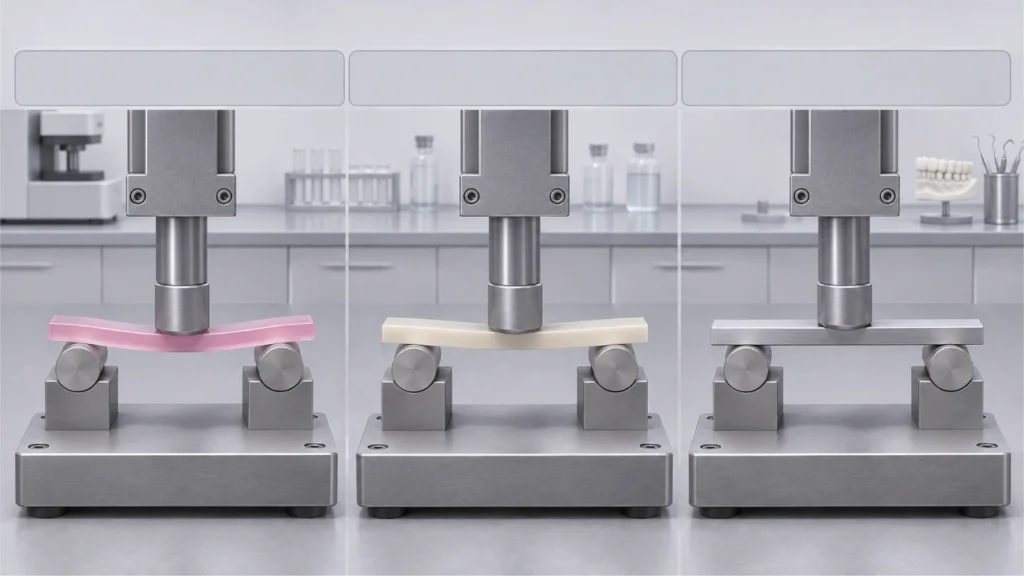
Flexural modulus (stiffness) is the single most useful number for choosing between these materials. The values below are representative laboratory values, not interchangeable product specifications.
Material | Representative flexural modulus | What it means in the mouth |
|---|---|---|
Nylon / polyamide | ~0.70 GPa | Flexes into undercuts, forgiving fit, but limited cross-arch rigidity. Load shifts toward the mucosa. |
Heat-cured PMMA | ~1.70 GPa | Rigid enough to carry an acrylic base; needs clasps for retention. |
Unfilled PEEK | from ~2.73 GPa (varies by formulation and test) | Framework-like behavior possible, but polymer clasps generally need different geometry from CoCr. |
Ultaire AKP | Passes ISO 20795-1 minimum for denture-base flexural modulus (>2,000 MPa) per the FDA submission; a specific GPa value was not published in the extracted comparison table | Rigid polymer alternative to a cast framework; still softer than metal. |
Titanium | ~110 GPa | Metal rigidity at lower weight. |
Cobalt-chromium | ~210 GPa | The baseline for cross-arch rigidity, support and predictable reline. |
Lower stiffness feels comfortable and reduces the chance of a thin clasp fracturing. The trade-off is less cross-arch rigidity, more movement under load, worse force distribution, and more tissue loading — particularly in a distal-extension saddle. That trade-off resolves most of the “comfort vs support” tension around these materials.
How these partials actually stay in
A common misconception is that flexible partials “suction” to the ridge. They don’t. Retention comes from a clasp arm engaging a tooth undercut: the arm flexes as it passes the height of contour, then recovers to seat against the undercut. Friction and tissue contact help, but as the PMC review notes, a close tissue fit is not a dependable substitute for a well-designed direct retainer.
Practical consequences:
- Shallow undercuts → unreliable retention regardless of material. Survey the model first.
- Polymer clasps need different geometry from CoCr clasps. Don’t copy the metal design.
- Hybrid cast designs — cast metal framework with polymer esthetic clasps on anterior teeth — keep rests, major connector and support in metal while hiding only the visible clasps.
Case selection: who should get which
Case selection is the first step of the prescription, not an afterthought. It decides whether the appliance survives in the mouth.
Reasonable candidates for a fully flexible nylon partial
- Short, bounded Kennedy Class III space.
- Several suitable remaining teeth with usable undercuts.
- Appearance is a primary driver.
- Patient accepts repair and reline limits and the possibility of needing a remake rather than a reline.
- Interim replacement after extraction or implant placement.
Patients who are generally not good candidates
- Kennedy Class I and II (distal-extension / free-end) saddles, especially long spans or with limited abutments. The flexible, tissue-supported base moves, loads the ridge, and nylon-to-reline bonding is difficult.
- Cases that need reliable rests, vertical stops, cross-arch rigidity or rotational control.
- Poor oral hygiene or unreliable recall — a flexible partial that isn’t maintained will stain, roughen and accumulate biofilm faster than acrylic.
- Short clinical crowns, few direct abutments, severe ridge atrophy, knife-edge ridges, heavy or unfavorable occlusion.
- Documented allergy to a specific material — the PMC review’s standard is a clinical assessment of what caused the reaction, not a self-reported “metal allergy.”
The Japanese Prosthodontic Society position distinguishes fully flexible appliances from rigid non-metal-clasp designs and cautions against treating fully flexible designs as routine definitive replacements. That matches our own experience: a flexible partial is a specific tool for a specific indication, not a default.
A quick triage matrix for prescriptions that arrive without a stated material:
Edentulous pattern | Few units, bounded | Long bounded span | Free-end (distal extension) |
|---|---|---|---|
Appearance critical, short-term | Flexible nylon / polyolefin or hybrid cast | Hybrid cast | Cast CoCr with esthetic clasps on anteriors only |
Appearance critical, long-term | Hybrid cast or rigid polymer (PEEK / AKP) | Cast CoCr or rigid polymer framework | Cast CoCr — polymer here is a compromise, not a solution |
Appearance secondary | Cast CoCr | Cast CoCr | Cast CoCr |
Patient has verified acrylic sensitivity | Rigid polymer framework | Rigid polymer framework | Case-by-case; often cast CoCr with alternative base |
Final design belongs with the treating clinician.
What the evidence actually supports (and doesn’t)
- A 2025 systematic review in Prosthesis (MDPI) found short follow-up, small studies and substantial risk of bias. It concluded that flexible dentures may improve esthetics and overall satisfaction, may be comparable on some outcomes, and may be inferior for retention; evidence of clinical equivalence to conventional RPDs was weak.
- The Canadian evidence review (available via NCBI Bookshelf, NBK619999) identified small trials and cohorts, most followed for one month to one year, some to 18–24 months. In one 120-person, one-year comparison, the Valplast group had no recorded clasp or base fractures, but artificial teeth were lost in 4 of 40 flexible appliances versus none in the CoCr or PMMA groups.
- A smaller 26-patient PEEK vs. CoCr RCT reported similar periodontal probing, bleeding and plaque indices at one year, and improved oral-health-related quality of life in both groups.
Favorable short-term comfort or esthetic ratings should not be read as proven long-term equivalence. The failure mode of flexible partials is also unusual — the most-cited one-year data shows tooth loss from the appliance, not framework fracture. Patients benefit from knowing that in advance, so a lost pontic at twelve months isn’t experienced as a surprise.
Hygiene, adjustment and the “do not” list
Patients who adjust their own appliance, or clean it the wrong way, bring it back faster than any mechanical issue. The limits for flexible resins differ from PMMA and are not always spelled out.
Follow the manufacturer’s instructions for the specific resin — Valplast’s own care guidance is a good reference — and share these with patients:
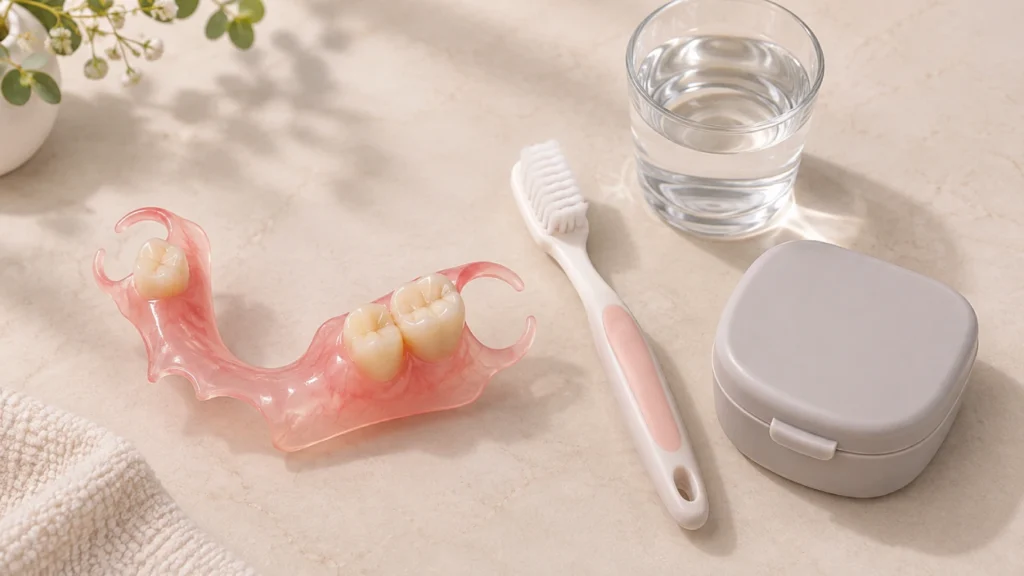
- Avoid household bleach, strong cleaners, hot or boiling water. Heat distorts thermoplastics; bleach degrades them.
- No chairside grinding on flexible resins without specific technique. Rough surfaces trap biofilm and stain.
- Tooth additions and relines go back to the lab, not to a bur in the chair.
- Daily cleaning matters — poor hygiene is a documented driver of denture-related stomatitis per ADA patient guidance.
A chairside leaflet for patients is included with every removable case shipped from Istar.
What we need in a prescription
A complete prescription makes the case buildable the first time. Anything missing from the list is what we come back to ask about:
- Diagnosis of the edentulous pattern (Kennedy class and modification).
- Chosen material family and the specific product (nylon vs polyolefin vs acetal vs PEEK vs AKP vs cast CoCr vs hybrid). If you’re not sure, mark “lab to propose” and we’ll come back with a design.
- Survey and path of insertion when known, or stone/digital model clean enough for us to survey.
- Rest seats, guide planes, undercut depths marked on the model or scan.
- Clasp type, location and whether esthetic clasps are required anteriorly — relevant for hybrid designs.
- Opposing arch, bite record, shade, and anterior reference photo for high-smile-line cases.
- Try-in requirement (wax try-in / tooth setup / none) and any staged review.
- Patient status for allergies, bruxism, xerostomia, implants present or planned.
For digital workflow, we accept STL, PLY and OBJ, plus 3Shape DCM native scans. We work with 3Shape TRIOS, Medit, iTero, CEREC (Sirona), Shining3D Aoralscan and Planmeca — any scanner that exports an open file. For conventional impressions, VPS or polyether is preferred; alginate doesn’t ship well internationally.
How Istar builds these cases
The removable department at Istar runs around 55 technicians and handles roughly 4,000 removable denture cases per month in normal season and up to 6,500 in peak season, with a backup workforce for seasonal load. Every case stays in-house end-to-end — we don’t outsource removable work to third-party labs.
The production flow for a partial:
- Case intake and completeness check. Prescription read against scan or impression; missing data flagged within one business day.
- CAD design. For cast frameworks and rigid polymer frameworks, every design is sent back for your written approval before production.
- Framework production.
- Cast CoCr: CAD → casting → fit check on master cast.
- PEEK / Ultaire AKP: CAD → milling from puck → fit check.
- Flexible nylon / polyolefin: block-out, tooth setup, wax-up, flasking, injection in the specified thermoplastic, deflasking.
- Acetal frameworks: CAD → milling or press.
- Tooth setup and wax try-in when prescribed. At wax try-in you can still change shade, surface effects, minor morphology and contact relationships.
- Finish and polish with technique matched to the resin — polyamide is finished differently from PMMA.
- Multi-stage QC at model, wax, setup and final stages.
- Final inspection against the approved design.
- Pack and ship by DHL / FedEx / UPS, with a tracking number sent at dispatch.
Case data (prescriptions, scans, photos) is stored on access-controlled systems. Patients are referred to by clinic case ID — we don’t require a patient name on the lab slip, and most of our clients submit a clinic case number instead. Case ownership stays with the clinic.
Equipment, materials and traceability
- Materials in stock for removable work: cobalt-chromium and Vitallium for cast frameworks, PMMA resins (Ivoclar, Shofu) for conventional bases, injection and milled thermoplastic systems, acetal pucks (e.g. Zirlux Acetal) for milled frameworks, resin teeth and porcelain teeth.
- Every case is bound to a unique ID that tracks the technician, equipment, material brand, batch number and QC results at each stage. Production records are retained for three months by default and longer by prior arrangement.
- Material certificates and batch numbers are available on request for any case shipped.
Regulatory posture
Istar holds active FDA facility registration, UK MHRA registration, EU MDR custom-device registration via authorized representatives, and ISO 13485 certification. Our material suppliers hold CE marks and ISO 10993 biocompatibility documentation. FDA registration is public and can be looked up directly in the FDA Establishment Registration & Device Listing database. Copies of our regulatory documents are available on request, within the scope of what each registration permits.
Istar is the lab. Clinical responsibility for patient care sits with the treating dentist, in line with the ADA’s statement on the dentist–lab relationship. We work to your written prescription and will raise questions in writing before changing anything about the design or material.
Lead time and remakes
Lead time
- In-lab production time is the same for digital and physical cases. Digital saves one to two days by avoiding model shipment and customs clearance.
- Design approval, missing data and client reply time are not counted in our stated lead time. The clock restarts when complete, approved data is in.
- Weekends and Chinese public holidays don’t produce; the schedule shifts around them.
- Technical issues mid-case — re-scan, re-impression or design change — are handled as priority cases so the client doesn’t lose the slot.
Remake and rework
- The rule for “clinical adjustment vs remake”: if the appliance can be seated and adjusted intraorally without changing structure, base extension or clasp geometry, it’s a chairside adjustment. If it can’t, it comes back. The line is drawn before the case ships, not after.
- Repair, reline, tooth addition — send the appliance back with the opposing model and a bite record if the occlusion needs to be preserved.
FAQ
Can every “metal clasps” case be rebuilt as metal-free?
No. Short bounded spaces with good remaining dentition — often. Long free-end saddles with limited abutments — usually not without compromise. Case selection, not material enthusiasm, drives the result.
Is Valplast “FDA-approved”?
FDA status is product-specific, not category-wide. The Dentivera (Ultaire AKP) 510(k) K160498 is a Class II clearance for that product and that labeled use. Any claim that a whole category of “flexible partials” is FDA-approved should be checked against the specific product’s documentation.
How long do flexible partials last?
Published and manufacturer-level data mostly cover one month to one or two years. The honest range to share with patients is three to seven years, shorter than well-designed cast frameworks (commonly five to ten-plus years), and heavily dependent on hygiene, occlusion and whether the clinical situation changes.
Can a flexible partial be relined, repaired or have a tooth added?
Sometimes, with real limits. Nylon-to-acrylic bonding is a known difficulty. Tooth additions should go to a qualified lab; chairside grinding tends to make things worse. For some patients, remake is more predictable than reline.
Are flexible partials hypoallergenic?
“No metal” doesn’t automatically mean “non-allergenic.” Biocompatibility depends on the specific resin and the specific patient. Allergy claims should be grounded in a clinical assessment, not inferred from material class.
Can you build a hybrid — metal framework with esthetic clasps?
Yes. Often the right answer when a patient wants to hide anterior clasps but the case needs real cross-arch rigidity. Call it out in the prescription and we design the framework around the esthetic clasp locations.
What about digital workflow?
We work from STL/PLY/OBJ and 3Shape DCM, we mill PEEK and acetal pucks, and we print models when needed. Scan quality drives everything downstream — we check and send back feedback within one business day.
Can we send a single test case?
Yes. Many of our current clients started that way. Send the data or ship the physical case; we build it against the same workflow as any other.
Working with us
Istar is a direct-manufacturing dental lab founded in 2012, running two facilities in Shenzhen and Huizhou. We’re a full-service lab — no outsourcing — with around 460 staff, including a 55-person removable denture team and a dedicated case-coordination team that works in English on US and European schedules. We’ve served over 50 labs, 100 clinics and 400 dentists across the US, Netherlands, Germany, France, Belgium, Austria, UK, Luxembourg and Switzerland.
For a specific partial case — metal, metal-free or hybrid — send the scan or impression and prescription and we’ll come back with a design proposal and a timeline. Factory visits and video audits are welcome at either site.
Sources
- Nonmetal clasp dentures: What is the evidence? — Journal of Prosthodontic Research review on PMC
- Clinical Assessment of Flexible and Non-Metal Clasp Dentures: Systematic review in Prosthesis, 2025 (MDPI)
- Nonmetal Clasp Dentures: CADTH evidence review — NCBI Bookshelf NBK619999
- Japanese Prosthodontic Society position paper on non-metal-clasp dentures
- FDA 510(k) K160498 — Dentivera / Ultaire AKP
- ISO 20795-1:2013 Denture base polymers
- Valplast FAQ and Valplast care instructions
- ADA guidance on the dentist–laboratory relationship
- ADA denture care and maintenance
- PEEK vs CoCr RCT (PubMed 33504721)
- FDA Establishment Registration & Device Listing search