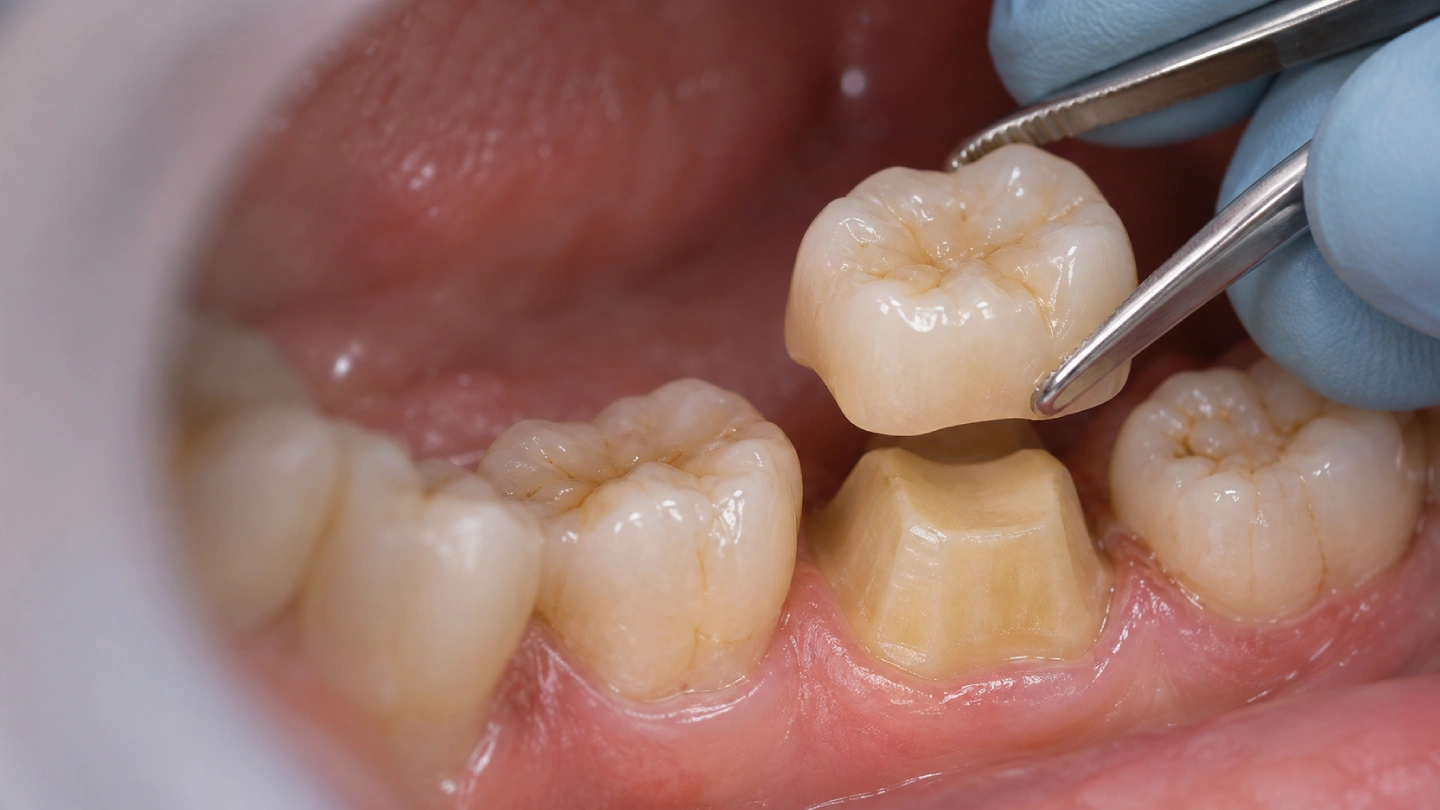
Cementing zirconia crowns comes down to one decision made before you even open the cement: lute it, or bond it. Pick the wrong route and the rest of the protocol can’t save the case. This guide walks through that decision, the chairside steps both routes share, and the handoff points at the dental lab — material generation, cement space, surface finish — that decide whether a crown stays seated five years out.
We built this page from a cross-section of in-vivo studies, manufacturer IFUs, and the day-to-day reality of running an in-house zirconia line.
Lute or Bond: Make This Call First
Zirconia doesn’t have a glass phase, so acid etching does nothing to it. That rules out the lithium-disilicate playbook. What you have left is two routes:
- Luting — the crown is held by mechanical retention from the preparation plus a conventional or self-adhesive cement acting mostly as a seal and gap-filler.
- Bonding — micromechanical retention from air abrasion plus chemical adhesion from a 10-MDP primer and a resin cement.
Both routes work. The choice is driven by how much retention the preparation gives you.
Decision Criteria
Preparation feature | If this is true | Route |
|---|---|---|
Axial wall height | ≥ 4 mm | Luting usually fine |
Taper | ≤ 20° from the long axis | Luting usually fine |
Occlusal convergence | Retentive, parallel-ish walls | Luting usually fine |
Short clinical crown | Axial wall < 4 mm | Bonding preferred |
Over-tapered or compromised retention | Taper > 20°, flared walls | Bonding preferred |
Partial-coverage design | Onlay, veneer-like coverage | Bonding required |
Implant-supported zirconia on a titanium base | Lab-side bond to the Ti-base | Bonding (resin + MDP) |
The practical read: if the prep is retentive, a resin-modified glass ionomer (RMGI) or self-adhesive resin cement will hold. If the prep is marginal, you need an MDP primer plus a dual-cure resin cement doing real adhesive work. A systematic review of tooth-supported crowns found zirconia survival rates between 83.3–100% for adhesive cementation and 82.0–100% for conventional cementation. The evidence quality was rated low and the review did not show a clear advantage for one approach, so the choice should be based on the preparation and the case, not on a universal rule.
What the Lab Decides Before the Crown Ships
Several variables that affect cementation are set during manufacturing. If they’re off, no cementation protocol compensates fully.
Material Generation: 3Y, 4Y, 5Y
Yttria content changes the balance between strength and translucency. We select the generation case-by-case:
Generation | Typical use | Trade-off |
|---|---|---|
3Y-TZP | Posterior single units, long-span bridges, heavy occlusion | Highest flexural strength, lowest translucency; benefits from transformation toughening |
4Y-PSZ | Posterior and premolar units needing some translucency | Balanced strength and esthetics |
5Y-PSZ | Anterior units, cases where esthetics outranks load | Translucency goes up, flexural strength comes down; adhesive cementation preferred for marginal retention |
Multi-layer discs ship as a single block with graded shading, but shading gradients are optical, not mechanical. The strength and the yttria content inside the disc stay consistent per layer section, which affects both occlusal-contact placement and your sandblast pressure. The published literature on these parameters remains limited; a scoping review on bonding strategies for zirconia fixed restorations notes 3Y restorations tend to show better bond strengths in short-term in-vitro aging, but study designs vary and the effect is lab-trend rather than a direct clinical rule.
At Istar we work with Aidite Yurucheng, Wieland Zenotec, and 3M Lava zirconia systems, and we tag the generation on every case report so the chairside team can match the cement route accordingly.
Cement Space (the Internal Gap)
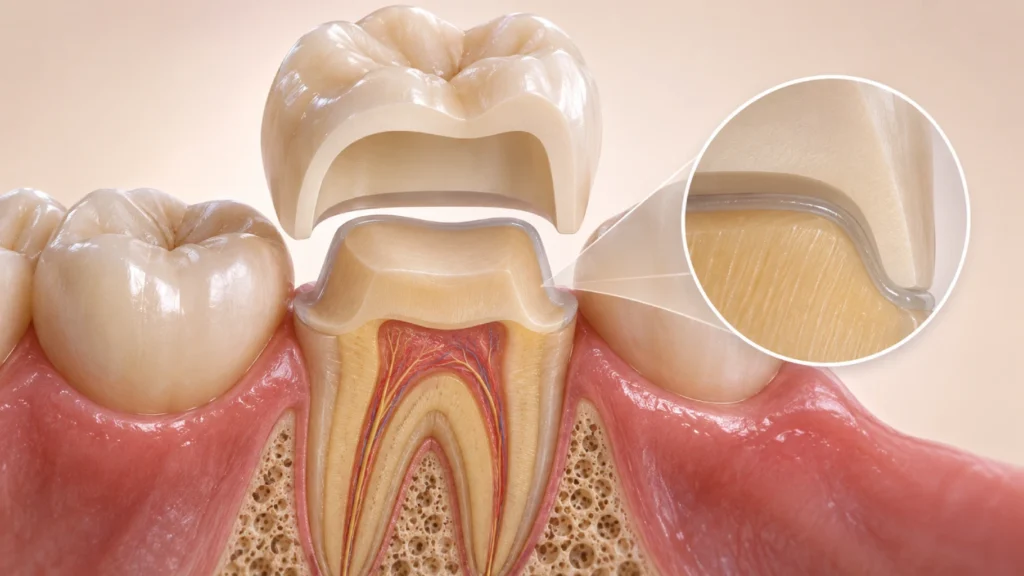
Cement space is the gap we design into the intaglio surface — not the actual cement film thickness. The two often get confused. Modern luting cements consistently seat below 25 µm film thickness when manipulated within the working time, but the CAD-defined space can be 30–80 µm depending on the system.
Over-spacing lets the crown seat easily but leaves a thicker cement layer, which is where cohesive failures start. Under-spacing produces a tight fit that may hang up on the margin and leave an open seat. Our default: 30–50 µm for monolithic single units, adjustable on request. Research on cement space and marginal fit shows the setting moves the marginal gap in measurable ways, so this is a real variable, not a cosmetic one. If you want a different setting for a specific cement system, note it on the Rx and we’ll adjust before milling.
Surface Finish at Delivery
Pre-sintered interior grooves on short-crown or over-tapered cases can be added at the lab in the pre-sintered state. We’ll flag the risk on prep evaluation and ask before we add anything. Post-sintered sandblasting, if requested, is 50 µm Al₂O₃ at a controlled pressure before packing. If you prefer to abrade chairside, we leave the intaglio untouched and the Rx is marked accordingly.
Istar runs CAD, milling, sintering, ceramic layering, and QC in-house across our Shenzhen and Huizhou facilities, with around 460 technicians and roughly 8,000 monthly zirconia single-unit capacity (up to 15,000 in peak season). The point is not the number — it’s that every case follows one internal protocol with its own sintering log and compensation record. No case gets re-outsourced.
The Chairside Protocol Both Routes Share
Everything below applies regardless of luting or bonding. Skip a step here and the route choice above stops mattering.
Step 1 — Try-In, Then Decontaminate
Saliva is the first adhesive problem. Zirconia has an unusually high affinity for salivary phosphates, which lock onto the surface and block MDP from doing its job. Rinsing and air-drying does not remove them. Options that work, with evidence:
Method | How | Evidence |
|---|---|---|
Zirconia-specific cleaner (Ivoclean, ZirClean, Katana Cleaner) | Apply to intaglio, wait 20 s, rinse, air-dry | Effective across independent cleaning-method reviews |
Air abrasion with 50 µm Al₂O₃ | 2 bar / 30 psi, ~15 s, from 2–3 cm | Mechanical removal; backed by the same systematic review |
5% NaClO | Apply to intaglio, wait 20 s, rinse, air-dry | Secondary option when a cleaner isn’t available |
Options that have been proposed but don’t work on zirconia: water alone, isopropyl alcohol, acetone, phosphoric acid, hydrofluoric acid. HF has no glass phase to etch and phosphoric acid competes with MDP for binding sites. If any of these touched the intaglio, re-decontaminate with one of the methods above.
A clean side note on MDP-containing cleaners (ZirClean, Katana Cleaner): because they already contain the active monomer, cleaning doubles as the first primer coat. You can go straight to the next step without re-priming.
Step 2 — Air Abrasion
Air abrasion creates the microretention zirconia needs. The parameters you’ll see across the literature don’t match, because they come from different generations, different cement systems, and different test rigs. Here’s the working envelope:
Source | Particle size | Pressure | Notes |
|---|---|---|---|
Published systematic review range | 0.5–4 bar | Cross-study distribution | |
PANAVIA V5 IFU | 0.1–0.4 MPa (15–58 psi) | Adjust by material and geometry | |
Blatz APC concept, clinical example | 50 µm Al₂O₃ | ~1.5 bar | |
Istar default (lab-side pre-delivery) | 50 µm Al₂O₃ | ~2 bar | Only when requested on the Rx |
The working rule: follow the IFU for the cement system you’re using, start on the lower pressure end for 5Y high-translucency discs, and move up for 3Y monolithic posterior units. Keep the time short (10–15 s is enough for retention) and keep the nozzle 2–3 cm from the intaglio to avoid chipping thin margins. After abrasion, rinse and dry — the air stream alone leaves residual particles that interfere with primer wetting.
Step 3 — MDP Primer
10-MDP (the phosphate ester monomer in Z-Prime Plus, Monobond Plus, Clearfil Ceramic Primer, Panavia tooth primer, and most “universal” zirconia primers) forms a phosphate-to-zirconia bond that silane cannot. The chemistry only works on a decontaminated, abraded surface — so Step 1 and Step 2 are prerequisites.
Application sticks to the IFU for the specific product, but the general procedure:
- Apply a thin, even coat with a microbrush
- Allow the reaction time stated on the bottle (typically 20–60 s)
- Air-thin with gentle, oil-free air for 3–5 s until the surface stops showing wet shine
Two things not to do:
- Don’t use a universal adhesive as a shortcut. The water and acidic resin monomers in a universal can inactivate MDP in the bottle itself. If you’re using a universal on the tooth, you still need a separate zirconia primer on the crown.
- Don’t substitute Monobond Etch & Prime (an HF + silane one-step product) for a zirconia primer. That product is formulated for silica-based ceramics; it contains silane, not MDP, and does nothing useful on zirconia.
The chemistry behind these constraints — reviewed across 93 bond-strength aging studies — is consistent: air abrasion plus a 10-MDP primer gives the most durable bond after artificial aging. Alternatives work in short-term tests but drift under aging stress.
Step 4 — Pick the Cement
Three categories cover almost every tooth-supported case:
Cement type | When it fits | What to know |
|---|---|---|
RMGI (RelyX Luting Plus, FujiCEM Evolve, GC FujiCEM 2) | Retentive preps, luting route | Resin-modified glass ionomer, ion-bonded to tooth, mechanical interlock on crown. In-vivo data shows low debond rates when the preparation gives real retention. Don’t combine with a bonding agent on the tooth — you lose the moisture tolerance that makes RMGI useful. |
Self-adhesive resin cement (RelyX Unicem 2, Panavia SA Cement Plus, SpeedCem Plus) | Mid-retentive preps, cases where moisture control is uncertain | Simpler protocol, acidic monomers etch dentin lightly. Not the same as a true bonded cement; retention relies more on seating than on chemistry. |
Dual-cure adhesive resin cement with MDP (Panavia V5, RelyX Ultimate, Variolink Esthetic DC) | Short crowns, over-tapered preps, partial coverage, implant Ti-base cases | Full adhesive bond. Needs separate tooth adhesive + zirconia primer. Opaque shades require a modified cure protocol (see Step 6). |
Two older options worth naming:
- Zinc phosphate is still used by some clinicians for highly retentive preps. Follow-up data shows a 3-year loss-of-retention rate around 12.5% versus 6.6% for self-adhesive resin on comparable cases. It seals a margin but offers no chemical bond to zirconia.
- Conventional glass ionomer (non-resin-modified) has a role in moisture-challenged cases. A 2025 RCT found 2-year performance similar to RMGI, so it’s not disqualified by data — it’s just more technique-sensitive for mixing and seating.
Step 5 — Seat
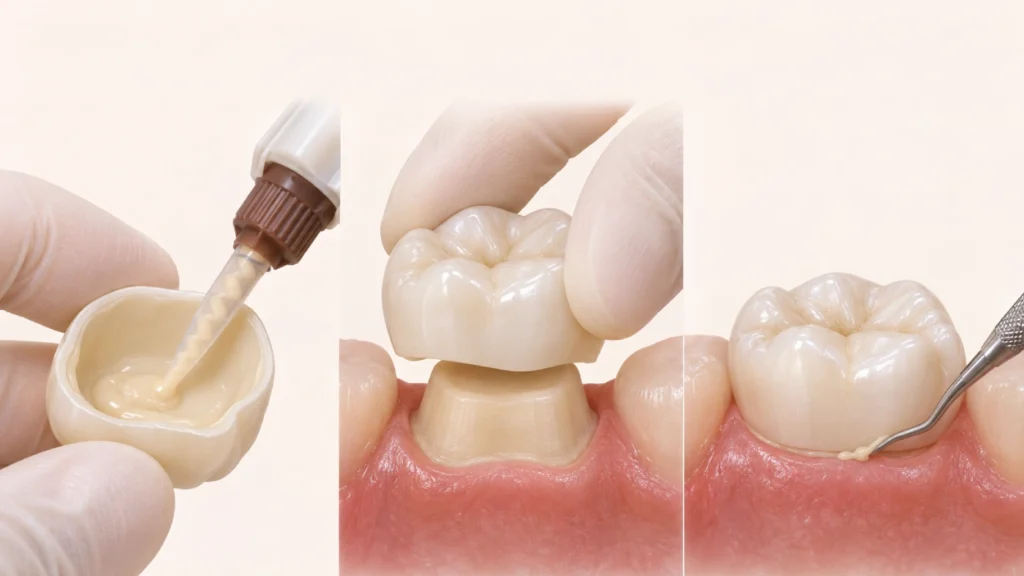
Dry the intaglio and the preparation. Load the cement, seat the crown with firm, continuous pressure, and hold until initial set.
Isolation matters more than it looks. Rubber dam is the cleanest option for bonding. If a dam isn’t workable, dry retraction cord plus continuous suction keeps the field controlled. Any blood or saliva that touches a primed intaglio restarts you at Step 1.
Step 6 — Tack Cure, Clean, Final Cure
For most shades, point-cure each surface for 3–5 seconds. The cement reaches a gel state — not full set. Flick off the margin excess with a scaler or floss while the cement is still gel-stage; this is a one-shot window. After clean-up, fully light-cure for the time the manufacturer specifies.
Opaque shades are the exception. Zirconia blocks light. For the darker and more opaque shades (and the thicker A/B5–B6 range), the standard tack cure will not reach the deep cement line. The PANAVIA V5 IFU spells out the alternative: skip the tack cure, brush away bulk excess with a brush soaked in cement, light-cure only the exposed margin for the standard time, and let the dark-cure chemistry finish the interior over roughly 3 minutes without disturbance. Confirm with your cement’s IFU — if your cement supports a longer light cure to compensate, that’s acceptable; if it doesn’t, chemical cure is the only reliable finish.
Zirconia’s opacity is a physical constraint, not a brand issue. Even high-translucency 5Y discs attenuate light enough that a dual-cure or self-cure pathway is the safe default, not a workaround. The PANAVIA V5 IFU and a Chairside Magazine systematic cementation reference both state this directly: don’t rely on light alone beneath opaque zirconia.
Step 7 — Occlusal Adjustment
Adjust occlusion after the cement reaches final set, not before. Adjusting on a partially set cement line can fracture thin cement margins or dislodge the crown. Use a fine diamond at under 20,000 RPM with water spray, then polish stepwise with zirconia polishers to restore surface smoothness. A rough occlusal surface wears opposing enamel faster than an unadjusted one would.
Troubleshooting: When a Crown Comes Off
Most “the cement failed” stories aren’t cement failures. They’re one of four things, and the failure mode is readable from where the cement sits.
Residue Diagnosis
What you see | What it means | Where to look |
|---|---|---|
Cement is entirely inside the crown, tooth is clean | Tooth-side preparation or priming was compromised — moisture, saliva, dentin not conditioned | Chairside: isolation, bonding agent application |
Cement is entirely on the tooth, crown intaglio is clean and shiny | Zirconia intaglio wasn’t properly cleaned or primed, or primer never bonded (silane-only product on zirconia, old primer, universal substituted) | Chairside: decontamination, MDP primer, time |
Cement is on both sides, torn in sheets, intaglio looks powdery-film | Cohesive failure within the cement layer itself — common when film is too thick or the cement was mixed/cured incorrectly | Lab-side: cement space; chairside: cement choice, light cure, humidity |
Cement is thin on both sides, interface looks clean, crown lifts easily | Incomplete seating — crown never fully seated at placement, often from under-spacing or an intraproximal hang-up | Lab-side: fit check, cement space |
The APC concept framed by Blatz and Alvarez uses this same residue-reading approach. It tells you where to look — it is a diagnostic prompt, not a definitive verdict. Multiple causes can overlap.
Recement or Remake
Recementing an intact crown is reasonable when:
- The crown comes off clean (no cement cohesion on either side, or clean cement on tooth only)
- The intaglio is undamaged
- The margin fit on the die or in the mouth is still accurate
- The preparation didn’t change
Remake is the honest answer when:
- The crown fractured, chipped, or has internal damage
- The preparation changed (new decay, fractured enamel, further reduction)
- The crown came off twice from the same prep — the issue is upstream of the cement
- Dark cement residue is baked into the intaglio and resists cleaning
For recementation, treat the intaglio as a new surface: decontaminate (zirconia cleaner or 50 µm Al₂O₃), re-prime with MDP, and cement with a dual-cure resin if the original route was adhesive. Cement coding (CDT D2920 covers recementation of an existing crown) is a chairside matter; the technical process doesn’t change based on billing.
If a case comes off twice, send us photos of the failed crown’s intaglio side and the preparation. We can read the residue pattern and tell you whether we see something diagnostically useful before you commit to a remake.
What Shows Up in the Data
A few numbers that are useful to have in a conversation with a patient or an operations review.
- 5-year clinical outcome, monolithic zirconia single crowns: a prospective study of 176 crowns in 112 patients reported 100% survival and 96.4% success at five years, with secondary caries at 2.2% and pulpal involvement at 0.5%. No fractures. No debonding events.
- Cement type and clinical outcomes: the systematic review cited above covering tooth-supported zirconia crowns found survival between 83.3–100% for adhesive cementation and 82.0–100% for conventional. Evidence quality was low; the review did not identify a clear winner.
- Zinc phosphate vs. self-adhesive resin, loss-of-retention at 3 years: 12.5% vs 6.6%.
- Immediate dentin sealing (IDS) for zirconia-cemented restorations: a review of four small studies found no statistically significant difference in postoperative sensitivity. IDS is not disqualified; it just isn’t shown to help here with current evidence.
- Postoperative sensitivity attribution: current literature does not reliably attribute post-cementation sensitivity to the cement chemistry itself. Short-term cold sensitivity (a few seconds) in the first 1–3 weeks is within the range reported for crown delivery broadly, and is managed with observation and desensitizers before considering remake.
Costs and Coding
There is no national price for a zirconia crown. The ADA Health Policy Institute stopped publishing its fee survey in 2023, so the only available numbers are market estimates. Consumer-facing data shows crowns are typically classified as a major service with roughly 50% coverage, subject to plan annual limits. Chairside billing codes: D2740 for the porcelain/ceramic crown delivery (zirconia falls under this code), D2920 for recementation of an existing crown. Pricing is a clinical and regional matter; it isn’t ours to set.
What is useful to know from the lab side: recement follow-ups cost us the same technician time as a new case when diagnostics are requested, but no new milling. If you ship us the failed crown and ask for a residue reading before you quote the patient, we don’t charge for the assessment.
Working With Us on These Cases
The lab-side variables above — generation, cement space, surface finish, pre-sintered modifications — are inputs on the Rx. If they’re not specified, we fall back to defaults appropriate for a monolithic posterior unit. Any of them can be set differently on request. The American College of Prosthodontists’ framework for lab–dentist relationships describes this as a prescription-based partnership: the clinician decides what the restoration should do; the lab decides how to make it do that; and when the Rx is ambiguous, the lab asks. We work the same way.
Three handoff requests we accept at no charge:
- Prep evaluation before milling. Send the scan with a note; we’ll flag reduction, taper, or margin issues against the cement route you plan to use.
- Case-specific generation and cement-space recommendation. Tell us the arch, the opposing dentition, and the intended cement system. We’ll match 3Y/4Y/5Y to the loading pattern and set the cement space accordingly.
- Failed-crown diagnostics. Ship the recovered crown or send photos of the intaglio. We’ll read the residue and tell you what we see.
Istar has been running these cases since 2012, with manufacturing in Shenzhen and Huizhou. We work with around 50 outsourcing labs, 100 clinics, and more than 400 dentists, mainly in the United States and across Europe. Factory visits — in person or by video — are routine, and we’re set up for them.
FAQ
Can zirconia crowns be bonded?
Yes. Bonding requires air abrasion plus a 10-MDP primer, followed by a resin cement. The chemistry is different from etching lithium disilicate — zirconia has no glass phase to etch — but the clinical bond is strong and holds in cases where retention from the preparation alone would be inadequate.
Do you have to etch zirconia before cementing?
Not with acid. Zirconia doesn’t respond to hydrofluoric acid, and phosphoric acid interferes with MDP priming rather than helping it. Mechanical surface activation (air abrasion with 50 µm Al₂O₃) replaces chemical etching for this material.
Can I use a universal adhesive on the zirconia intaglio instead of a separate MDP primer?
No. The water and acidic monomers in a universal adhesive can inactivate the MDP in the bottle itself over time, and in the single-step workflow the formulation is optimized for enamel and dentin rather than zirconia. A dedicated zirconia primer stays separate from your tooth-side adhesive.
Does the cement space I set at the lab change the actual film thickness in the mouth?
Partially. Film thickness depends on cement viscosity, mixing, and seating pressure, and sits below 25 µm for modern cements when manipulated correctly. The CAD cement space is a design input that affects how easily the crown seats and how thick the deepest cement layer gets. We can adjust the setting per case; just note the target on the Rx.
Why would a crown come off with cement still stuck to the tooth?
That pattern points to the intaglio side: incomplete decontamination, no MDP primer, a silane-only primer used by mistake, or an inactivated primer bottle. The tooth-side bond held; the zirconia-side chemistry didn’t form.
My Opaque-shade bonded crown isn’t curing all the way through. What’s happening?
Light can’t penetrate dark zirconia deeply enough for a standard tack cure to work. Switch to the manufacturer’s chemical-cure protocol: brush off excess with a cement-wetted brush, light-cure the exposed margin only, and allow the dark-cure chemistry three minutes without disturbance.
Can I recement an adhesively bonded crown that fell off?
Yes, if the crown and preparation are intact. Treat the intaglio as a new surface: clean (zirconia cleaner or 50 µm sandblast), re-prime with MDP, and cement with the same route as before. If the crown came off twice from the same preparation, the issue is upstream of the cement.
Send Us the Case
If you have a case where cementing zirconia crowns has become a repeat problem — pulled restorations, uncertain cement choice, or a question about generation or cement space before milling — contact the sales team on our main page. We’ll get a case coordinator on it the same working day.