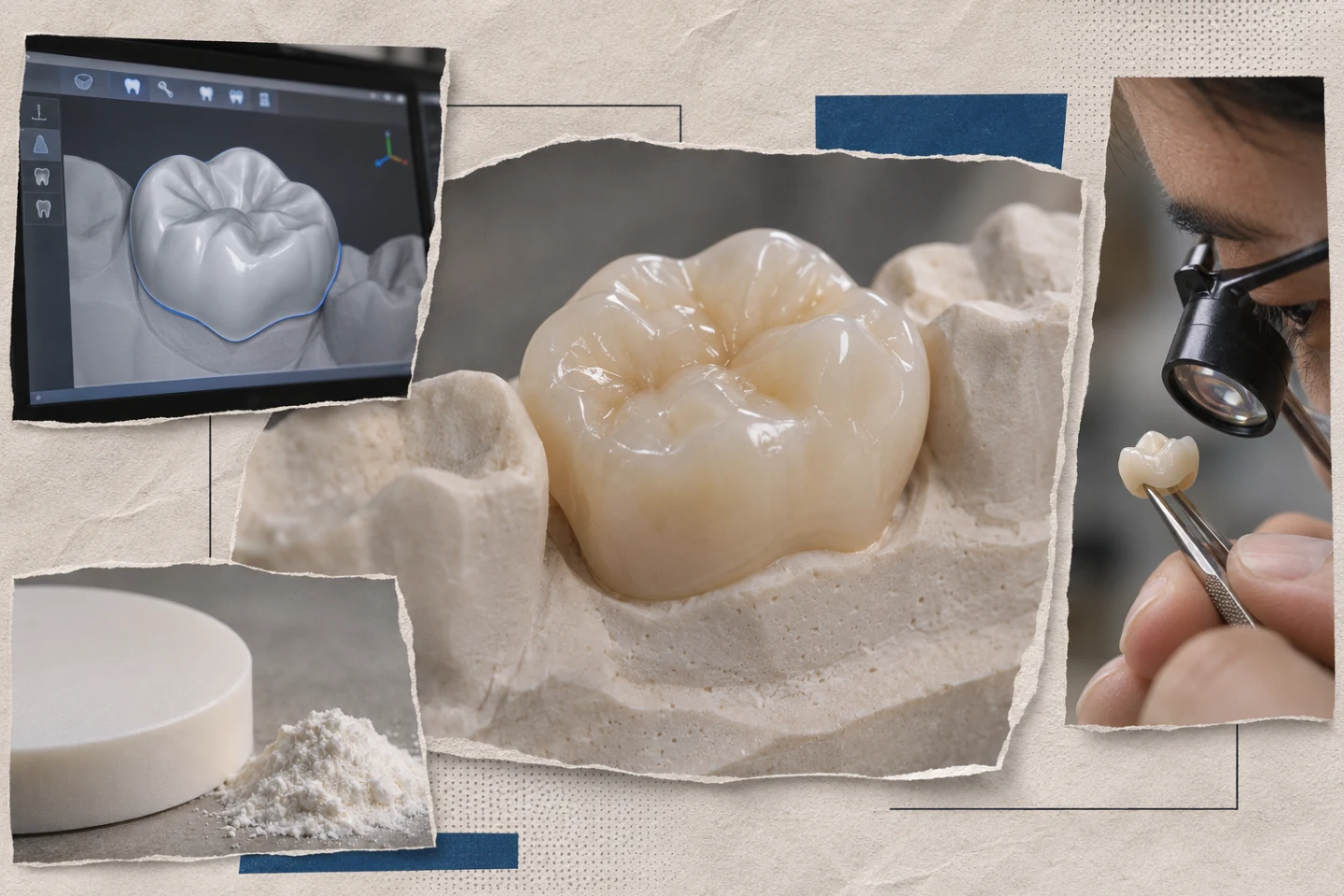
Zirconia in dentistry is now the default material for most posterior crowns and a growing share of anterior work. It holds up under bite load, it mills cleanly from a digital workflow, and the newer multilayer blanks finally look like teeth.
Harder questions sit beyond the datasheet: how the strength numbers were measured, where survival really drops off, which prep errors a lab can rescue in CAD and which it can’t, and how to handle insurance pushback on ceramic and zirconia crowns under the D2740 code. Istar Dental Lab has been producing zirconia restorations since 2012, and the specs, workflow decisions, and failure patterns that follow come from that case history.
Zirconia, zirconium, cubic zirconia, ceramic — which one are we actually talking about
Three terms get swapped around in prescriptions and chair-side conversations:
- Zirconia is zirconium dioxide (ZrO₂). It’s a technical ceramic.
- Zirconium is the metal element. It isn’t what gets milled into a crown.
- Cubic zirconia is a jewelry stone, not a dental material.
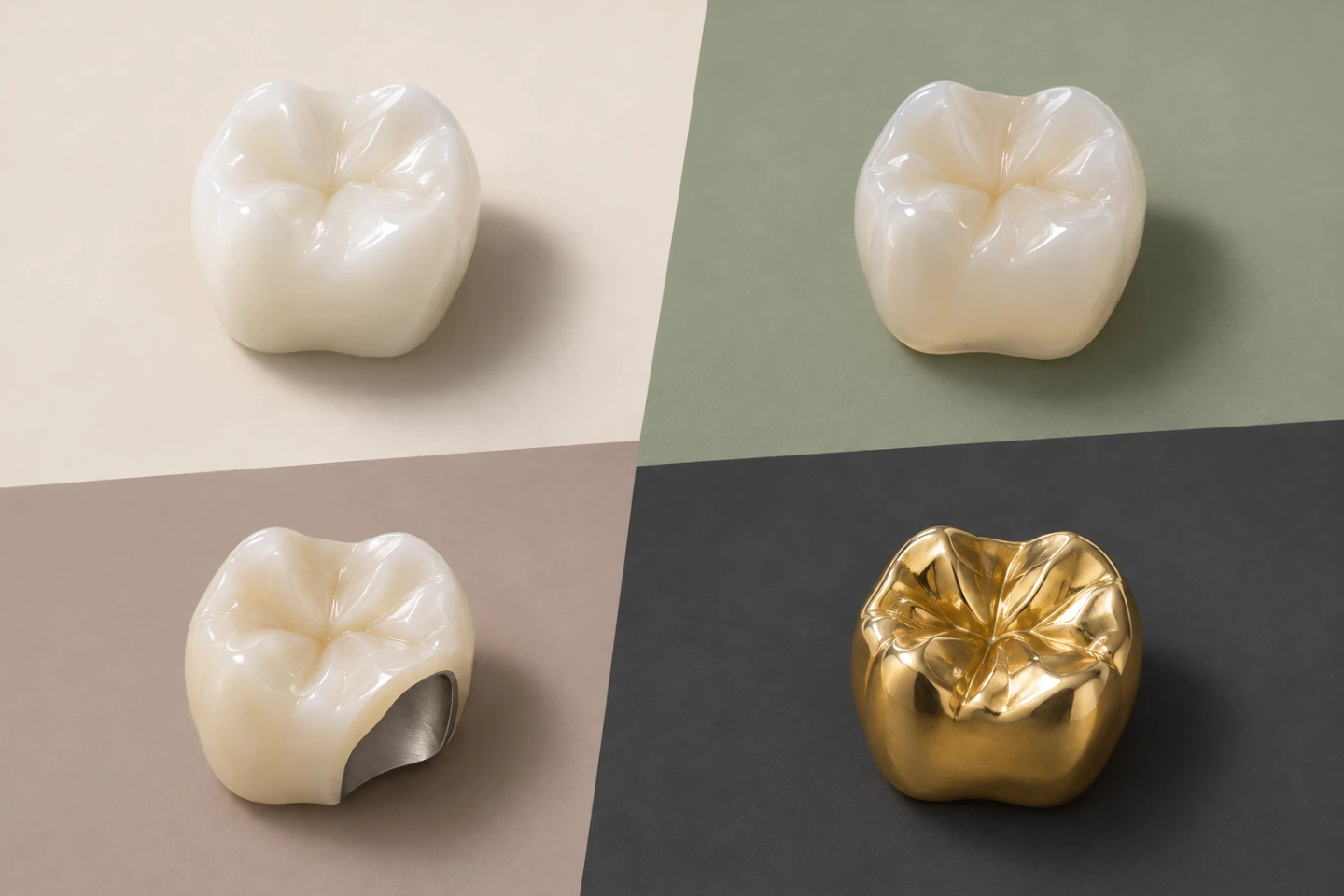
Zirconia sits inside a bigger family: dental ceramics. That family also includes lithium disilicate (e.max), feldspathic porcelains, and layered zirconia-glass hybrids. When a patient or an insurance plan asks about “ceramic and zirconia crowns” as if they were two different things, they’re using everyday language — a zirconia crown is a ceramic crown. The real split sits inside the ceramic family, between glass ceramics (bond-friendly, more translucent) and polycrystalline ceramics like zirconia (stronger, more conservative to bond). The classification itself is codified in ISO 6872:2024, Dentistry — Ceramic materials, which groups dental ceramics by indication and strength class. The two sub-groups also require completely different cementation chemistry.
Which generation of zirconia for which tooth
Yttria content changes everything downstream. More yttria pushes the microstructure toward cubic phase, which gives better translucency but drops flexural strength. Less yttria keeps more tetragonal phase, which keeps strength up but limits how lifelike the material looks.
3Y, 4Y, 5Y — the three generations in one line each
The three ranges on blank specs:
| Generation | Yttria (mol%) | Reported flexural strength | Where it fits |
|---|---|---|---|
| 3Y (first generation) | ~3 | ~900–1400 MPa | Posterior full-contour crowns, long-span frameworks, bruxism cases |
| 4Y | ~4 | ~900–1000 MPa | Posterior to premolar single units where some translucency is needed |
| 5Y (high-translucent) | ~5 | ~500–800 MPa | Anterior crowns, veneers, cases where esthetics outranks occlusal load |
Those ranges come from the current dental-zirconia literature and vary with test method, specimen thickness, surface condition, and sintering — see the overview in Recent Advances in Dental Zirconia and the classification work in Current classification of zirconia in dentistry. Always confirm against the specific blank’s manufacturer IFU before specifying.
Monolithic, multilayer, veneered — the three structures
On top of generation, there’s structure:
- Monolithic single-shade zirconia: one uniform block. Strongest, flat optics. Fine for posteriors and night-grinders.
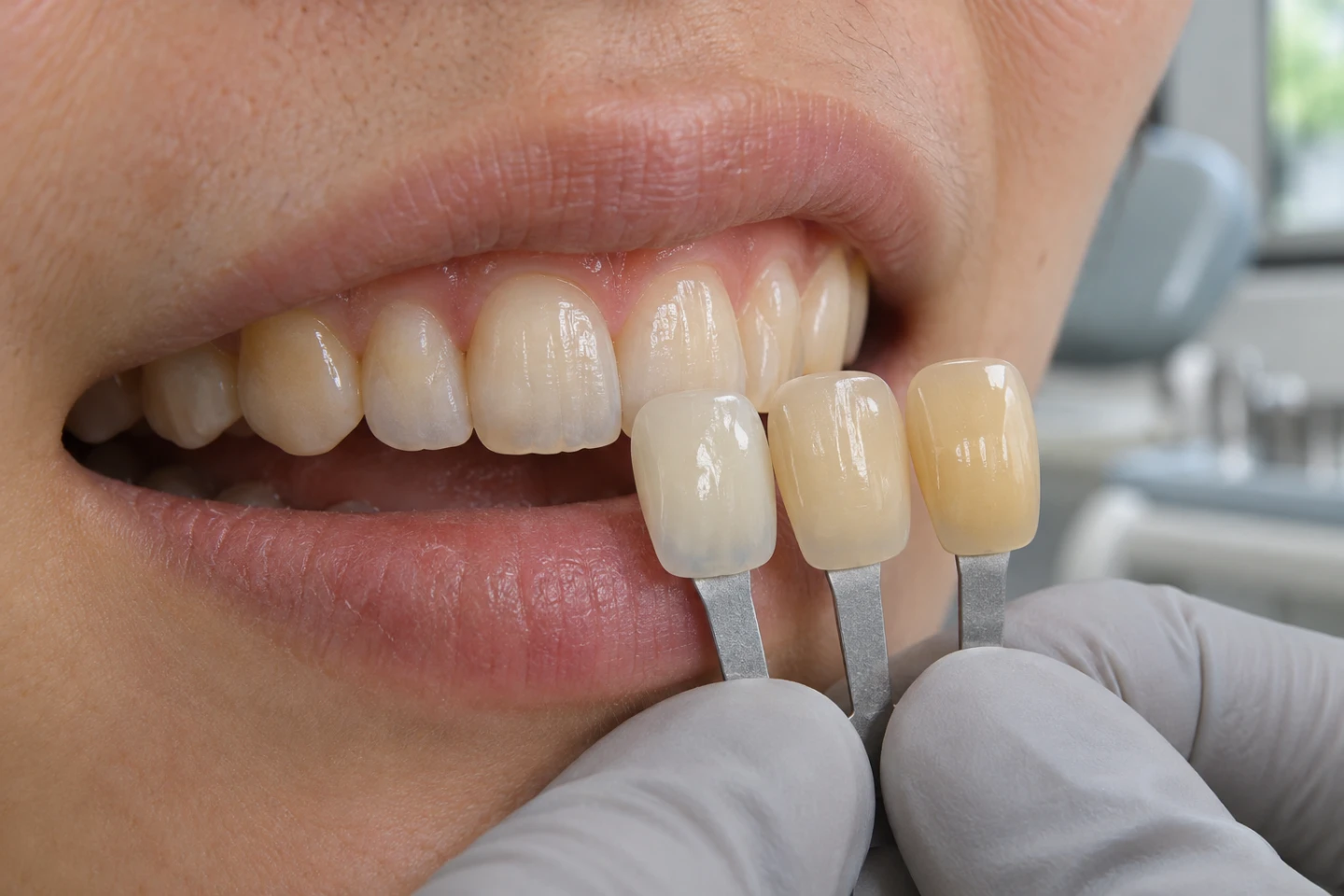
- Multilayer zirconia: still one block, but color and translucency grade from cervical to incisal. The practical choice for anterior full-contour cases — strength plus layered optics without the risk of a veneered restoration.
- Veneered zirconia (zirconia coping + layered feldspathic porcelain): the highest esthetic ceiling, and the most failure modes, because the veneer layer can chip independently of the coping. Reserved for esthetic cases with stable occlusion and adequate prep space.
How selection happens in CAD
The four variables that actually decide which blank gets loaded are: tooth position, available prep space, occlusal load pattern, and whether the opposing tooth is enamel, metal, or another ceramic. Everything else is secondary.
Reading flexural strength and survival numbers
Why “1200 MPa” and “850 MPa” can describe the same material
Flexural strength on a datasheet looks like a hard number. It isn’t. The same blank can be reported at 1200 MPa or 850 MPa depending on how it was tested — three-point versus four-point bend, whether the specimens were as-sintered or polished, specimen dimensions, and which ISO 6872 class the manufacturer is reporting against. Two blanks compared under different test configurations aren’t actually being compared.
Survival, success, and the follow-up length behind the number
Survival rates have the same problem, just with more variables. The systematic review and meta-analysis of tooth-supported monolithic zirconia vs. porcelain-veneered zirconia FDPs reports high short-to-medium term survival for both, but survival and success are not the same thing. Survival means the restoration is still in the mouth. Success means it’s still in the mouth and nothing has failed — no chipping, no secondary caries, no cementation loss, no debonding. A framework can “survive” while the veneering porcelain has already chipped twice.
Three distinctions matter when a published survival figure comes up:
- Framework survival vs full-crown survival — framework-only tracking ignores veneer failures.
- Survival vs success — the first is a yes/no, the second has defined failure criteria.
- Follow-up length — a 94% figure at 3 years and a 94% figure at 10 years describe very different materials.
Istar’s internal remake rate across all restoration categories is 2–3%, mixed-cause: production errors, prep or impression issues, and design changes requested after approval all count toward it.
Thickness, prep, and marginal fit
Most of the preventable remakes trace back to decisions made before milling: minimum thickness, margin design, and the quality of the data the lab is working from.
Minimum occlusal reduction by generation and position
Minimum thickness depends on generation and position. 3Y monolithic tolerates thinner occlusal reduction than 5Y high-translucent. Veneered zirconia needs enough space for both the coping and the layered ceramic, which is why esthetic anterior cases run tight when the prep wasn’t planned for a layered restoration. Always confirm the blank manufacturer’s minimum against the design, not the other way around.
Margin design by material
General recommendations by material:
- Layered zirconia and PFM: shoulder margin.
- Monolithic zirconia, lithium disilicate: feather edge, mini-chamfer, or chamfered shoulder, depending on esthetic requirements.
Shoulder margins on monolithic zirconia tend to over-bulk the cervical third. Feather or chamfer margins on layered zirconia or PFM lead to inconsistent coping thickness. Those pairings aren’t dogma — they just cause the fewest problems downstream.
Sintering shrinkage and compensation
Sintering shrinkage is around 20% but varies by blank, by batch, and by sintering furnace. The software compensation value comes from the manufacturer’s IFU for each blank; every new batch gets verified with a reference test piece before it goes into production, and the compensation parameters get rechecked on a schedule. A new batch with a different compensation value than the previous one triggers a trial piece. This is why marginal fit on the model usually isn’t a sintering issue — it’s a prep edge or scan edge issue.
How marginal and internal fit get checked
Fit is checked at two points: on the model after sintering and glazing, and again at final QC. Edges have to look even with no lift-off, the internal surface has to be free of burrs or sintered-in grit, and the proximal contact has to seat without a flick. The check is model-based, by eye and under magnification. If a margin looks off, the trace-back goes to the design file and the scan, in that order.
Scans that can be rescued, scans that can’t
- Can usually recover: small voids outside the preparation area, minor noise on the facial of an unprepared adjacent tooth, soft tissue noise away from the finish line.
- Can’t recover: ambiguous or missing finish line, deep sub-gingival margin without retraction, bubbles or pulls at the shoulder, movement on long-arch cases. In those scans, production stops and a rescan or repour gets requested. A design built on a bad margin ends up as a remake.
Surface prep and cementation — the part that doesn’t translate across ceramics
Why hydrofluoric acid does nothing on zirconia
Zirconia has no glass phase. Hydrofluoric acid etches glass. Zirconia is a polycrystalline ceramic, so HF does nothing on zirconia — and residue from an HF application can actually drop subsequent bond strength by leaving surface contamination.
The protocol that actually works
- Air-particle abrasion with 50 µm aluminum oxide at a controlled pressure. The goal is micro-roughness, not mass removal.
- Clean and dry immediately. Any oil or saliva residue drops bond strength.
- MDP-containing primer or self-adhesive resin cement with MDP. The 10-MDP monomer bonds chemically to zirconia’s surface oxides. For the evidence base see Adhesion to Zirconia: A Systematic Review of Surface Pretreatments and Resin Cements, the newer scoping review of bonding strategies for zirconia fixed restorations, and a review of techniques for enhancing zirconia bond strength.
- Cement gap designed to the 20–50 µm range for most cases, which gives room for the luting cement without compromising seating. For titanium-base bonding on implant cases, the same MDP protocol applies, with the implant interface masked during air abrasion.
Zirconia versus glass ceramic: which cementation path
Glass ceramics (lithium disilicate, feldspathic) run the opposite chemistry: HF etch, rinse, dry, silane couple, then resin cement. A quick decision rule:
- Zirconia or PFM → conventional cementation (resin-modified glass ionomer or self-adhesive resin), or MDP-based adhesive cementation when retention is marginal.
- Lithium disilicate, feldspathic, veneers → adhesive cementation with HF + silane.
Details depend on prep retention, isolation, and whether the margin is on enamel or dentin.
Failure modes — what to expect, what gets tracked, what to do when it happens
A zirconia crown fails in a limited number of ways, and the fix path depends on which one.
Chipping — monolithic versus veneered
On a monolithic crown, a chip is cohesive failure of the zirconia itself, usually at a corner near a thin spot or a sharp line angle. On a veneered crown, the chip is almost always in the veneering ceramic layer (adhesive or cohesive failure within the veneer), not in the coping. A chipped monolithic unit usually means a remake; a chipped veneer can sometimes be polished and recontoured chair-side if small, or re-veneered if large. A photo at the moment the clinic sees it, kept with the original case data, is what makes it possible to trace the failure site back to the design file.
Opposing tooth wear
The variables are the restoration material, the surface finish of the restoration, and the patient’s bite habits. Natural teeth wear opposite to glazed and polished ceramic crowns reports that glazed and polished zirconia produce different wear profiles against enamel. The umbrella review of antagonist enamel wear and the network meta-analysis across different ceramic systems each isolate different parts of the question.
Polished monolithic zirconia tends to be gentler on enamel than glazed-and-not-re-polished zirconia, and ceramic class also matters — with lithium disilicate causing less mean vertical loss than metal-ceramic or monolithic zirconia in some clinical samples. The practical takeaway for a lab is to re-polish any chair-side adjustment zone before the crown goes back.
Low-temperature degradation (LTD)
Zirconia undergoes a slow tetragonal-to-monoclinic phase transformation in a moist environment. Accelerated hydrothermal aging testing — typically around 134°C and 0.2 MPa, following ISO 13356’s protocol — is how manufacturers characterize this; a representative study is Evaluation of Feasibility on Dental Zirconia—Accelerated Aging Test. The accelerated protocol is a materials test, not a direct hours-to-years conversion for a crown in the mouth. Higher-yttria blanks (4Y, 5Y) contain more cubic phase and are less susceptible to the classic LTD mechanism, but that benefit comes with reduced transformation toughening.
Cementation loss and debonding
Almost always a protocol problem: contaminated intaglio, no air abrasion, wrong cement for the retention form, or a prep with insufficient taper and height. A clean, lightly abraded intaglio ships from the lab in sealed packaging; the chair-side side is the right primer and cement for the retention case.
Marginal opening after delivery
Could be the impression, could be the scan, could be a sintering distortion on a long span, could be an unidentified rock on the model. Triage order: scan or impression first, then model, then framework. For long-span zirconia (five units or more), the span gets supported during sintering and the seat gets rechecked on the model after sintering, specifically for this reason.
Reporting a failure, and the remake policy
A photo to the WhatsApp case group with the original case number is the fastest path. For chipped or fractured units, keep the piece if possible. For non-seating or margin-opening complaints, a new impression or scan is usually required — the old data can’t say what changed in the mouth.
Fit failures, margin failures, occlusal errors, and clear esthetic defects that trace back to lab-side work are remade without charge. Material changes, color changes requested after approval, and work completed on an impression flagged as borderline before starting are cases where there may be a charge, discussed before producing. Full remake terms live on the Shipping and Policy page.
Standards, verification, and billing codes
Material standards: ISO 6872 and ISO 13356
Dental ceramics are classified by ISO 6872:2024, which defines flexural strength classes, chemical solubility limits, and intended indications. For implant-grade zirconia, ISO 13356:2015, Implants for surgery — Ceramic materials based on yttria-stabilized tetragonal zirconia (Y-TZP) is the applicable standard. The ISO 6872 class answers “what grade is this blank” more cleanly than a brand name does.
Regulatory status in the US and the EU
In the US, finished custom restorations shipped into the country are produced under FDA establishment registration and device listing. A public example of a 510(k) decision on a zirconia-adjacent dental product is K240574; FDA’s Class II special-controls guidance for root-form endosseous dental implants and abutments is the reference document for the implant side.
In the EU, custom-made dental restorations fall under MDR Annex XIII. The device risk class for a crown is IIa, but custom-made devices don’t carry a CE mark through a Notified Body — the lab issues a Statement for Custom-Made Devices, retains the technical documentation, and the authorized representative registers the notification with the competent authority (EUDAMED). A clinic can request this document to put in the patient file.
US billing codes and the D2740 question
The applicable ADA CDT codes for porcelain and ceramic crowns live in the D2000 and D6000 ranges — D2740 for a porcelain/ceramic crown, D6245 for a porcelain/ceramic pontic in a bridge, among others. Codes are revised annually; verify the current year with the ADA before submission. Where a plan rejects a D2740 claim on a zirconia crown with the reasoning that zirconia “isn’t ceramic,” the ISO 6872 classification of zirconia in dentistry puts the material inside the dental ceramics family by definition — that standard is the technical reference an appeal letter can lean on.
Documents available for the case file
On request:
- A material traceability sheet per case: blank brand, generation, lot, sinter cycle used.
- The Statement for Custom-Made Devices for EU shipments.
- FDA establishment and listing information for US shipments.
- Signed NDA, quality agreement, or supplier agreement per the client’s procurement requirements.
Most cases don’t need any of this. When a claim gets denied, a DSO runs a supplier audit, or a European authority asks for documentation, these are the documents that answer the question.
How a zirconia case moves through Istar
- Blanks in rotation: Aidite and Upcera on the domestic side; Wieland, Zirkonzahn, and 3M Lava on the imported side; Ivoclar for the glass-ceramic category. Blank choice follows the indication and the clinician’s preference; IFU plus batch records travel with every blank.
- Files accepted: STL, PLY, OBJ, DCM, and native 3Shape or exocad files. For an unusual format, a sample case gets a compatibility check first.
- Turnaround: 2–3 lab days for a routine zirconia crown or bridge, starting from an approved design and complete case data. Design-approval waiting time and missing data pause the clock, not consume it. Design-only cases typically come back inside 24 hours.
- Scope: full workflow, or any sub-step — design only, mill-and-sinter only, porcelain and finish only.
The full nine-step zirconia workflow — intake, CAD, model, mill, sinter, layer and glaze (where applicable), polish, QC, pack — runs inside Istar’s own facilities in Shenzhen and Huizhou. Implant abutments, full-arch screw-retained restorations, and orthodontic appliances follow different prescription workflows and have their own dedicated pages. Capacity, team structure, and audit access live on the About pages.
FAQ
Does a try-in paste need to be fully removed before cementation?
Yes, and not with water alone. Try-in paste residue is one of the common reasons a documented MDP protocol still underperforms. Rinse, then clean the intaglio with isopropyl alcohol or a dedicated zirconia cleaning solution before applying the primer. Phosphate-based cleaners work; some labs use a brief re-blast with 50 µm Al₂O₃ at low pressure if the intaglio has been handled extensively.
Can zirconia be used for a cantilever bridge?
A short cantilever on 3Y monolithic zirconia is sometimes acceptable in a stable occlusion with a healthy abutment and conservative connector sizing, but it’s not a default indication. Connector cross-section becomes the limiting factor, and the pontic end is where chipping or crack propagation tends to initiate. Clinical judgment and the specific blank’s manufacturer guidance decide the case, not a general rule.
Why does the same zirconia blank get specified at different connector sizes in different design software?
Different CAD libraries apply different safety margins to the same strength data. The connector cross-section is derived from assumed bending moment and a safety factor, and vendors don’t always expose which factor they used. For load-bearing designs — long spans, bruxers, cantilevers — the fallback is the blank manufacturer’s published minimum connector table, not whatever the CAD library auto-fills.
Does a specific cement work better for zirconia?
For retentive preps, conventional cementation with a resin-modified glass ionomer is fine. Switch to MDP-based adhesive cementation when retention is marginal, when the margin sits on dentin, or when the span is long. A plain resin cement without an MDP step tends to lose bond strength over time; the MDP primer is what gives the durable chemical bond on zirconia’s surface oxides.
Does a zirconia crown block X-ray imaging of the margin?
Zirconia is radiopaque enough that overhanging cement and gross marginal gaps show up on bitewings, but it also attenuates the beam more than enamel, so very early secondary caries at a sub-gingival margin can be harder to catch radiographically. For recall intervals on zirconia crowns at risk, the practical move is a tighter clinical check in addition to the usual radiographs, not a longer gap between them.
Which crown lasts longer, zirconia or glass ceramic?
Both have high survival rates in the published systematic reviews when used within their indications. The honest answer isn’t a single number: monolithic zirconia tolerates heavier occlusal load and larger spans, while glass ceramics tend to be preferred for high-esthetic anterior single units with sound bonding substrate.